
In January of 2020 (I know, right?) I was suddenly possessed by a weird little idea.
This happens to me fairly often, but the various ideas are rarely similar to one another. It’s always a moment of zingy clarity, like taking the first sip of an icy lemonade. It’s like a chilled refreshment arriving to solve a nagging thirst you weren’t even quite aware of yet.
In any case, this idea was a script. A snappy 10-minute two-hander of a play, in which the dialogue changes every performance–and no, it’s not improvised.
It was a typical late January day in Denver, Colorado: shallow drifts of tired snow draped the landscape, and nobody felt like doing just about anything, myself included. As a long-time Pinterest devotee, I was scrolling my feed, swiping away the crafts and clothes in favor of something a little less tangible: motivation. The wise and successful among us have published plenty of pithy proverbs over the years, and I was in dire need of inspiration. No quote quite encapsulated what I needed to feel in order to get going, however, and I kept searching, searching, searching for more.
That escalation of need, in which nothing you encounter is quite enough for you, and where there is a sort of substance that acts a substitute for genuine meaning… that reminded me of something else, which perhaps you might buy in a back alley somewhere. Stereotypically speaking.
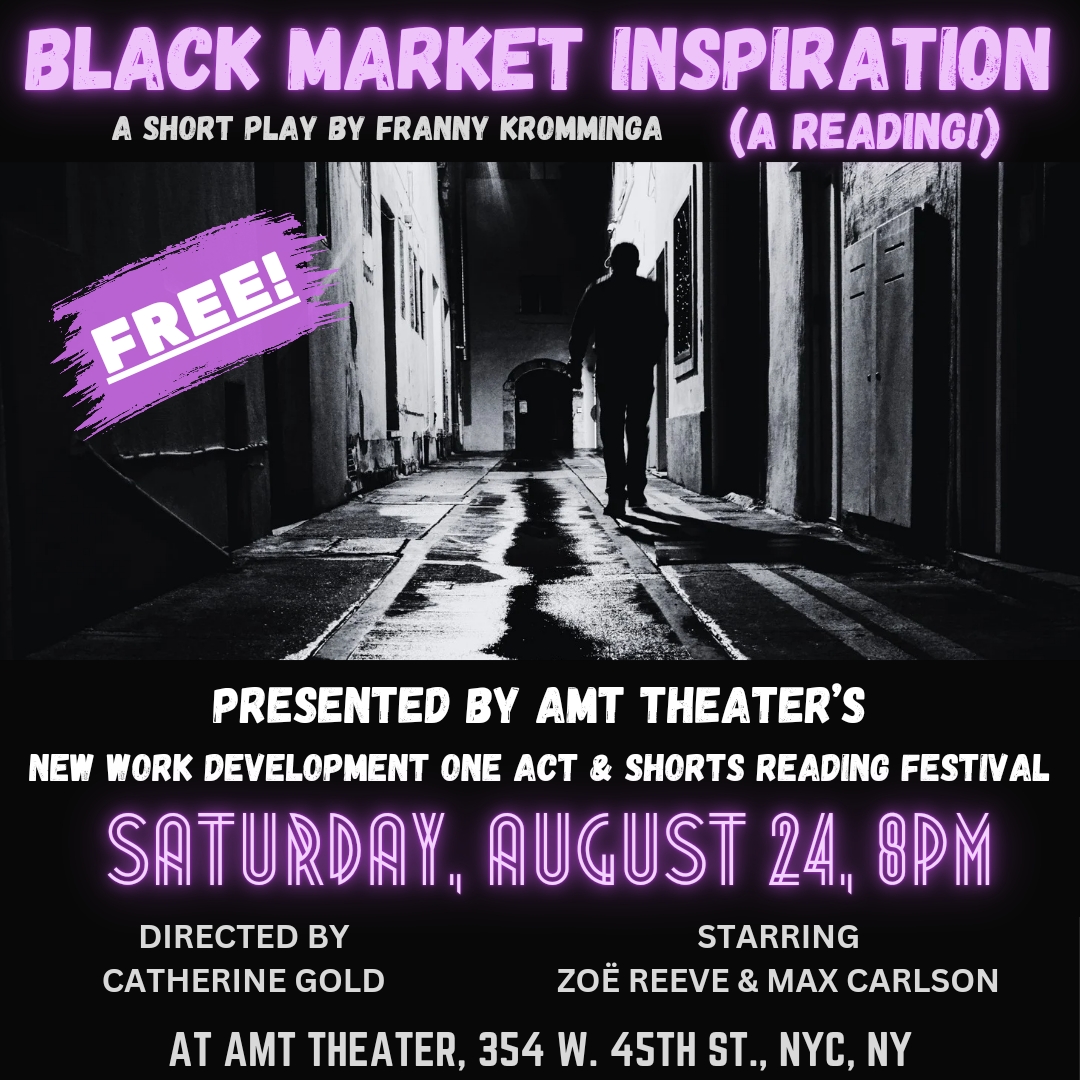
Thus was born Black Market Inspiration, a play about the moment between inspiration and action, about when motivational quotes are just chronic avoidance in a pretty, prose-y package. There are two characters, a seller and a buyer, and lots of little plastic baggies full of white stuff–you know, little scrolls of white paper with quotes printed on them!
I wrote the whole thing in a day (admittedly… it is only 10 minutes long). And while the initial idea was the driving force, I’m equally delighted by what I would call the script mechanics of the piece: the script is made up of about 60% attributed quotes, and only a few of those are designed to remain static in every production of this play. The rest of the play can (and in my opinion, should) be memorized in terms of structure. This means the actor can then organically, in the moment, pull and read random quotes that are on the prop scrolls, and still be able to maintain the rising and falling action of the play. The script notes how to accomplish this, in context, via staging directions.
I chose to incorporate this element of unpredictability specifically because this is a PLAY, intended to be performed live. Sure, there’s a polished version that could be an excellent short film, and maybe I’ll experiment in that direction sometime, but the final product would lose all the charm of idiosyncratic experience, which is what live theater is all about. What an audience deserves is consistency, but what it wants is something one-of-a-kind, unrepeatable. This is why so many people love when something goes just a little bit wrong onstage, or why concert-goers collect set lists. There is magic (and marketability, now that you mention it) when you can combine consistent performance with a little bit of controlled mystery.
I have always loved when shows are able to tap into this unique energy; two examples from my musical-theatre-brain are The 25th Annual Putnam County Spelling Bee, and The Mystery of Edwin Drood. Both of these pieces utilize planned chaos: Spelling Bee brings up audience members to “compete,” and Drood, with the original novel left unfinished by author Charles Dickens, allows the audience to vote between several possible endings. This is by no means a new strategy, but I find it’s an important and delightful way to distinguish the value of live performance separately from recorded media.
So, I mentioned I wrote this in 2020, and it’s currently 2025… you may be wondering what happened between then and now.
I submitted it to a few short play competitions, and then the pandemic hit, and I let my nicely formatted document slumber in my Dropbox for four years. Then, in the summer of ’24, my director friend Catherine posted on Instagram, looking for playwright collaborators to submit to a competition/festival at AMT Theater in NYC. I happened to see her post, nearly submitted my script too late, and completely forgot about it afterwards, expecting another rejection. I was totally surprised to be informed that it had been selected after all, for the New Works Development Festival at AMT. My little kindergarten-age script would finally learn to read receive a reading.
That reading took place in August 2024, and I actually had the wherewithal to record it. The chutzpah to edit and publish, however, only arrived last week. Enjoy!
With enormous thanks to AMT Theater and my terrific team:
DIRECTOR: Catherine Gold
PERSON 1: Zoë Reeve
PERSON 2: Max Carlson
 The Franifesto