Confessions of a Former Barista

Coffee lovers, prepare to throw your tomatoes:

In 2018-2019, I worked at a bustling Starbucks in the heart of downtown Portland, Oregon, right across the street from City Hall. At that time, there was a bit of pride to being a Starbucks worker, especially so close to headquarters and the original store in Seattle–this was also, arguably, their peak social awareness era, famously shutting down their stores for a day in order to facilitate anti-discrimination training, following a very public racially-motivated incident in Philadelphia earlier that year. (Since then, unfortunately, Starbucks as a corporation has made more and more unfortunate decisions, and I gladly support the baristas currently attempting to unionize and improve circumstances.)

I spent many, many mornings parallel-parking my huge hand-me-down Chevy Silverado in downtown Portland at 4:30AM, running the peak opening shift from 5-9, and then somehow taking a nap and then doing rehearsals/performances of Mamma Mia! in the evenings until after 11PM… and I still managed to avoid caffeine addiction, despite all the free espresso. I was never the fastest at the bar, but I held my own, even when making Mike’s horrible 4-shots-espresso-4-pumps-mocha-4-pumps-white-mocha-heavy-cream-no-ice-iced-latte on repeat. This was also the era of the keto diet, so everyone was convinced a heavy cream latte was better for them than their usual soy vanilla… oy vey.

Anyway, credentials verified: confession time.

These days, I start my day with french-press black coffee, sometimes with a splash of cold oat milk.

I don’t make the coffee, my husband does. He’s never been a barista.

When I inevitably forget about my coffee long enough for it to go tepid, I top it off with whatever is left in the french press (which, awkwardly for our household, only brews three cups’ worth).

If the press is empty and we decide we need more, I just sprinkle fresh grounds on top of what’s already there, and re-brew as-is.

If the press is empty but my coffee is cold, I just turn on the electric kettle, and top up my cup with hot water, weakening the coffee.

If I forget the coffee until cold multiple times, I will continue topping it off with hot water, until it is a weak facsimile of what it used to be, basically brown hot water, and this continues in perpetuity, sometimes until the very end of the day.

We actually have an espresso machine that came with our apartment, and I haven’t learned to use it yet. It’s been 8 months.

Even though I CAN make an excellent coconut-mocha-latte-with-cinnamon-steamed-in, I don’t.

Coffee connoisseurs, I’m aware I commit several unforgivable sins daily. But in the end, the most barista-ish coffee order to have is simply coffee you don’t have to make yourself.

Standard

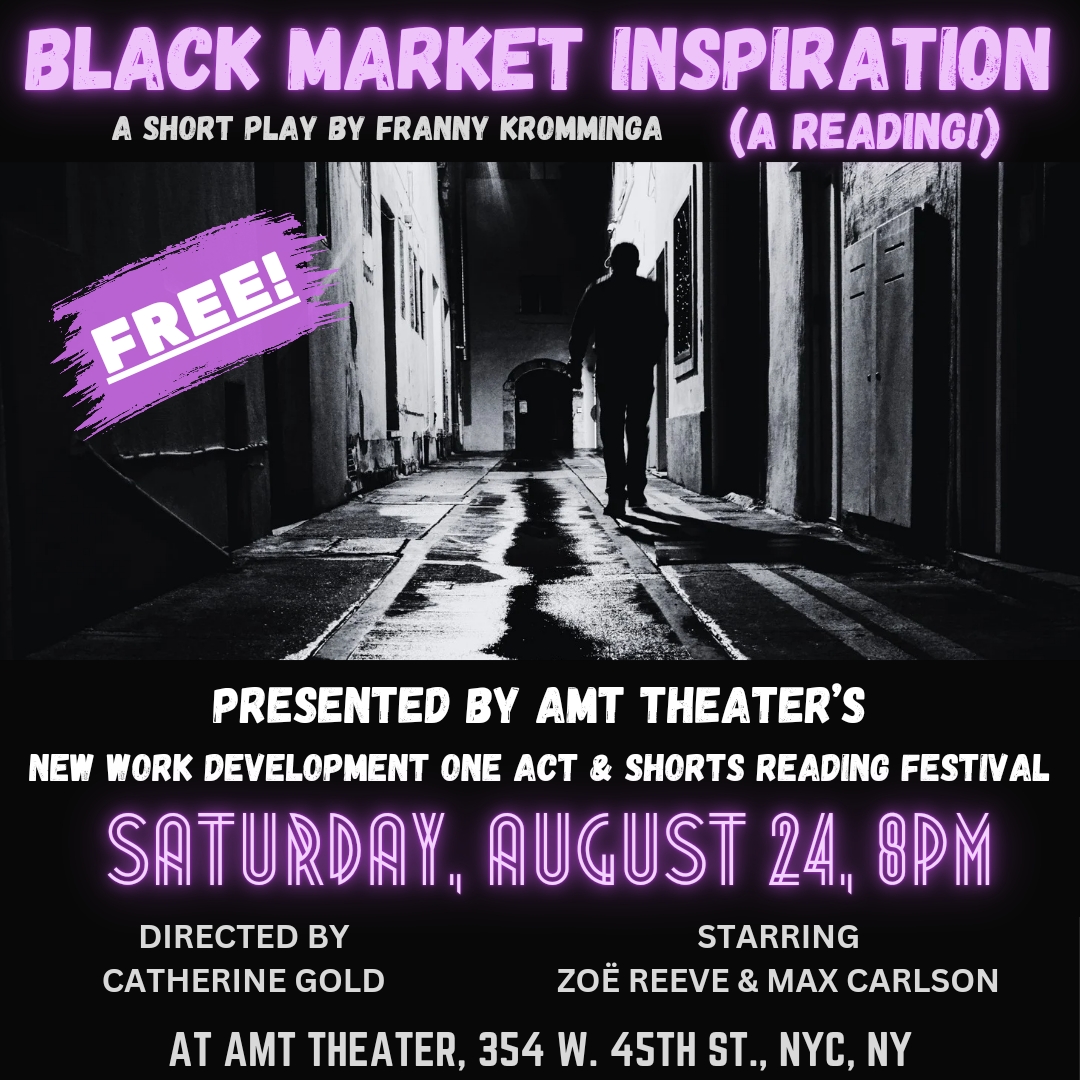
“Black Market Inspiration,” a Short Play

In January of 2020 (I know, right?) I was suddenly possessed by a weird little idea.

This happens to me fairly often, but the various ideas are rarely similar to one another. It’s always a moment of zingy clarity, like taking the first sip of an icy lemonade. It’s like a chilled refreshment arriving to solve a nagging thirst you weren’t even quite aware of yet.

In any case, this idea was a script. A snappy 10-minute two-hander of a play, in which the dialogue changes every performance–and no, it’s not improvised.

It was a typical late January day in Denver, Colorado: shallow drifts of tired snow draped the landscape, and nobody felt like doing just about anything, myself included. As a long-time Pinterest devotee, I was scrolling my feed, swiping away the crafts and clothes in favor of something a little less tangible: motivation. The wise and successful among us have published plenty of pithy proverbs over the years, and I was in dire need of inspiration. No quote quite encapsulated what I needed to feel in order to get going, however, and I kept searching, searching, searching for more.

That escalation of need, in which nothing you encounter is quite enough for you, and where there is a sort of substance that acts a substitute for genuine meaning… that reminded me of something else, which perhaps you might buy in a back alley somewhere. Stereotypically speaking.

Thus was born Black Market Inspiration, a play about the moment between inspiration and action, about when motivational quotes are just chronic avoidance in a pretty, prose-y package. There are two characters, a seller and a buyer, and lots of little plastic baggies full of white stuff–you know, little scrolls of white paper with quotes printed on them!

I wrote the whole thing in a day (admittedly… it is only 10 minutes long). And while the initial idea was the driving force, I’m equally delighted by what I would call the script mechanics of the piece: the script is made up of about 60% attributed quotes, and only a few of those are designed to remain static in every production of this play. The rest of the play can (and in my opinion, should) be memorized in terms of structure. This means the actor can then organically, in the moment, pull and read random quotes that are on the prop scrolls, and still be able to maintain the rising and falling action of the play. The script notes how to accomplish this, in context, via staging directions.

I chose to incorporate this element of unpredictability specifically because this is a PLAY, intended to be performed live. Sure, there’s a polished version that could be an excellent short film, and maybe I’ll experiment in that direction sometime, but the final product would lose all the charm of idiosyncratic experience, which is what live theater is all about. What an audience deserves is consistency, but what it wants is something one-of-a-kind, unrepeatable. This is why so many people love when something goes just a little bit wrong onstage, or why concert-goers collect set lists. There is magic (and marketability, now that you mention it) when you can combine consistent performance with a little bit of controlled mystery.

I have always loved when shows are able to tap into this unique energy; two examples from my musical-theatre-brain are The 25th Annual Putnam County Spelling Bee, and The Mystery of Edwin Drood. Both of these pieces utilize planned chaos: Spelling Bee brings up audience members to “compete,” and Drood, with the original novel left unfinished by author Charles Dickens, allows the audience to vote between several possible endings. This is by no means a new strategy, but I find it’s an important and delightful way to distinguish the value of live performance separately from recorded media.

So, I mentioned I wrote this in 2020, and it’s currently 2025… you may be wondering what happened between then and now.

I submitted it to a few short play competitions, and then the pandemic hit, and I let my nicely formatted document slumber in my Dropbox for four years. Then, in the summer of ’24, my director friend Catherine posted on Instagram, looking for playwright collaborators to submit to a competition/festival at AMT Theater in NYC. I happened to see her post, nearly submitted my script too late, and completely forgot about it afterwards, expecting another rejection. I was totally surprised to be informed that it had been selected after all, for the New Works Development Festival at AMT. My little kindergarten-age script would finally learn to read receive a reading.

That reading took place in August 2024, and I actually had the wherewithal to record it. The chutzpah to edit and publish, however, only arrived last week. Enjoy!

With enormous thanks to AMT Theater and my terrific team:
DIRECTOR: Catherine Gold
PERSON 1: Zoë Reeve
PERSON 2: Max Carlson

Standard

Social Media, the Attention Economy, Art, and Ethics

I have a fraught relationship with Social Media.

It’s wonderful to be able to keep tabs on long-distance friends and relatives, to be able to share thoughts and photos instantly… but it also feels like a moral failing, contributing my labor (however minuscule) to the Attention Economy: allowing Meta, or TikTok, or Twitter, to profit from my ability and desire to communicate and connect with others.

I certainly haven’t always felt this way. I was in 8th grade in 2008, and I vividly remember borrowing my mom’s work BlackBerry for hours after school, sorting through the mobile-incompatible pages to look at Facebook “flair.” We didn’t have regular internet in our home until after I had gone to college, but I still somehow managed to post a LOT of unfiltered, deliciously cringy Millennial-era content on Facebook, which I’m slowly deleting even now. Instagram followed thereafter, and I joyously posted grainy food pics and selfies along with some of the earliest adopters. Twitter was, controversially, my favorite, because I loved reading everyone’s quippy “live-tweeted” thoughts.

This was before those platforms changed, removing chronological feeds, and monetizing via (even more) ads, shopping, and subscription “verification.” This was before I knew what an algorithm was. This was before “meta” was Meta, before Elon Musk bought Twitter, before ChatGPT and Sora, before I had read Digital Minimalism by Cal Newport, before doomscrolling.

The fact of the matter is, Social Media has led us into a new economic model: the Attention Economy. Just like how printed newspapers sell ad space inside, based on their readership, so too can online platforms; the difference is that a newspaper ends on a daily basis, and a website can be endless. Social Media sites earn more money the more time that viewers spend perusing them, and so they are financially incentivized to make those platforms as time-absorbingly addictive as possible–and they do. These platforms have increasingly homogenized, and these days they all operate exactly like slot machines: you never know what each swipe or scroll may bring, and you’ll never get the same page curated twice. Personalized algorithms create bubbles of feedback which uncritically reinforce our views and increase social divisions. The barrier of the internet lets some people feel safe to bully and harass, protected by distance and anonymity. Bot farms produce hundreds of thousands of comments, which can be inflammatory, misleading, or both. Now AI muddles our perception of reality, throwing additional confusion into a time period where “Truth” is both a Social Media platform and a vicious debate. Perhaps worst of all, the Attention Economy steals our time, energy, motivation, dreams, while we barely notice it.

In a society where the average person already makes too little money, the Attention Economy preys upon the last possible resource we have to give: our time. We freely contribute to this maelstrom, in the hopes of getting a tiny fraction of that attention back–in the form of business traffic, outside validation, or internet fame–but there’s no guaranteed return on investment, and the cost is steep. In recent years, more and more studies on Social Media’s effects on us have come out: we know that our attention spans are shortening, our tolerance for mental discomfort is lessening, our memories are suffering, and our collective social stress is through the roof. Unsurprisingly, the same billionaires who head these platforms keep screens away from their own children, sending them to analog schools and keeping their faces offline. Through Social Media use, our self-perception warps, leading to decreased self-esteem, body image issues, and such dystopian trends as “Instagram face.” The popularity of AI has made all of these issues exponentially worse, from the spread of misinformation and scams to increasingly unattainable self-expectations.

“So, Franny, it sounds like you just hate Social Media.”

Well, no. On the bright side, Social Media is in many ways a great equalizer in terms of connection and opportunity, and has completely changed the game when it comes to operating a business and generating publicity. It has enabled thousands of ordinary voices to be heard, artworks to be shared, and vital news and information to be transferred, all faster than ever before.

Herein lies the personal conflict: I’m an artist. I write, paint, take photos, sing, perform. An artist’s job is to share their art, therefore, I must publish my work: moreover, I believe in increasing access to art as a whole. Because of the way the world has developed, these platforms continue to be the most accessible way to share a message or image with others, and to grow a community. If you are hoping to communicate an idea quickly and/or internationally, Social Media is perhaps the poor communicator’s only option.

This instant globalizing prowess has always been the charm and value of Social Media, but as it currently stands, when I myself am trying to cut down on a doomscrolling habit that I’m sure has negatively impacted my life, is it reasonable to ask others to keep scrolling for MY content? It’s the same reason I was a terrible salesperson back when I worked on commission at the makeup counter at Kohl’s: how could I possibly ethically persuade someone to buy a product, when I couldn’t afford it, myself? I may not have known a customer’s financial situation, but I know for sure they didn’t need a $50 eyeshadow palette… and it has always felt predatory to pretend otherwise.

I stopped posting as actively on Social Media back in November 2020, when that USA election cycle, combined with the COVID-19 pandemic, proved that every online disagreement was fruitless (at least at that time). I deleted Twitter the day it was sold. I wiped my TikTok profile earlier this year. And yet, despite my own choices, I am still scrolling, and still susceptible to twinges of envy when I see others freely, seemingly guiltlessly, sharing.

This blog, The Franifesto, is in part a manifestation of this frustration: I wanted a place of my own, where my opinions are less likely to be subject to censorship and algorithm, where I can post any amount of any kind of media, structure it any way I like, and control my narrative… but, of course, it completely lacks that magical element of community. It seems I must share more consistently on those flawed, established, popular, annoying platforms, but I worry about the hypocrisy of doing so. Posting there seems to puncture my points.

In the end, I know it’s not my job to make the choice for others whether and what they consume, and how much. Why not my work? Has my microscopic protest withheld anything from those in power? Or just from myself?

Paradoxically, the ability to incite change in this unsatisfactory system will almost certainly require participating within it.

Perhaps it’s enough to be aware of the conflict, acknowledge it, and make a post to talk about it. Perhaps it’s enough to ask other artists, and other doomscrollers, what they think. Perhaps it’s enough to simply use what tools we have, while they exist.

So: what are you doing, about/with/for/against/because of Social Media?

Lately, I’ve been:

  1. Implementing a weekly no-scroll day (Wednesdays for me. If I accidentally start, I just stop as soon as I realize.)
  2. Trying to limit my scrolling to ~2 hours or less a day. (Shamefully difficult.)
  3. Trying to engage with Social Media intentionally (such as actively liking my friends’ content, amplifying speakers from historically underrepresented groups, sharing important information, advocating for causes).
  4. Engaging in long-form attention habits (meditation, studying a new language, reading books, creative hobbies).
  5. “Create more than consume.” Of course the creative cycle requires consuming new media, knowledge, connections, inspiration, but it’s easy to get out of balance if you never synthesize what you’re consuming into something new. (Digest it, if you will, or you’ll end up creatively… blocked.)

All this to say… take a scroll break. Unless you like my work. In that case, I guess, take a break after you’re done reading. 🖤

Standard

NEW! Online Course: How I Became Successful: How to Teach an Online Course & Sell Newsletters *Available Now*

[Image: mirror selfie of young woman in a black bikini, who appears to be at a resort]

People have been asking me for ages now; “you’ve gotten incredibly successful. How did you do it?”

Well, here’s how.

“Your Instagram is amazing! How are you doing so great?”

I’ll tell you!

“You’re going so many places! How can you afford all that?”

You want to know! So I made this online course, “How I Became Successful: How to Teach an Online Course & Sell Newsletters,” exclusively for all of you, to finally really explain how it’s done.

[Image: photo of a dusty chalkboard ripped from Google Images, uncredited]

You know I’m successful, because I show it off all the time. It’s obvious in every coyly-smiling mirror selfie. I love sharing my life with you online! You always know what I’m up to: mirror selfie while shopping, mirror selfie at the Italian restaurant, mirror selfie from three months ago when I looked really skinnyyyy and took pics in three different bikinis (and I haven’t worn them since).

But enough about me and how you see me all the time. We’re here to talk about “How I Became Successful: How to Teach an Online Course & Sell Newsletters,” an entirely different and serious topic.

When thinking of the best, most efficient way to tackle “How I Became Successful: How to Teach an Online Course & Sell Newsletters,” I originally wanted to share this gold mine of information on social media with the rest of my content, for free. By the people, for the people! However, it quickly became clear that “How I Became Successful: How to Teach an Online Course & Sell Newsletters” was just too big of an idea. I just can’t do justice to it on Instagram, or TikTok, or even YouTube.

So, we (my super talented and large production team that I definitely hired and I, obviously) made the incredibly difficult decision that all six hours of this vital content should be made available to you individually and directly, on Vimeo, with a one-time-use passcode. It’s simply the best way forward, for the sake of my content and for your learning experience.

[Image: a grid of four video screenshots from “How I Became Successful: How to Teach an Online Course & Sell Newsletters”]

The four separate hour-and-a-half lectures took days to complete, as I found more and more roundabout ways of sharing the true message of “How I Became Successful: How to Teach an Online Course & Sell Newsletters.” I can hardly express how electrifying it was, speaking into that ring light and imagining how many of you would pay to watch this, and hopefully be truly inspired by the things you learn in “How I Became Successful: How to Teach an Online Course & Sell Newsletters.” What a dream!

I pre-recorded each lesson, so I would never have to try to teach this course ever again; I just know I could never replicate the things I said for these lessons. I was full of it–full of love and hope and joy–and I know it will infuse you when you experience your first-and-only binge-watch of “How I Became Successful: How to Teach an Online Course & Sell Newsletters.” In fact, I have a special little story to tell only you, dear newsletter readers, about what happened while filming “Lesson Two: How Two, The Next Step Up.” It’s about our camerawoman. And don’t worry, I totally have permission to share this story!!!

[Image: a blurry vertical photo of a young woman in a black sweatshirt, standing in a corner of the room]

We had just been through two hours of grueling filming. My notecards got messed up, and I could not figure out what order my outline was supposed to be in! Was it “Success” first, or “Online Course” first? It sometimes makes me laugh that I still get things like that mixed up. It just goes to show, even an expert in the field like me can still get a little jumbled, and that’s okay.

I had finally fixed my notecards, and we were on take number one when I heard a small sniffle. Was that me? No: I breathed deeply through my nose; I was feeling fine. Maybe someone else in the room…?

Another sniffle. I looked beyond the iPhone screen perched in the middle of the ring light, beyond my own glowing face, and there was another face. Of course, I thought to myself, how could I forget Jessica the camerawoman?

“Why are you sniffling? If I can hear it, the camera heard it.” I asked, with care.

Jessica sniffed. “Oh sorry yeah, this morning I mentioned I had a cold–?”

“Well there’s toilet paper in the bathroom.” I said in a nice way.

Jessica sniffed. “Yeah I have sumb.” (***Author’s Note: I spelled “some” like sumb in order to mimic her stuffy-nose sound, and I think the effect turned out rather nicely.)

“I won’t pay you if I can hear your sniffles.” I cautioned gently, trying to anticipate her needs.

Jessica sniffed louder. “I mean, that’s not–you need me, I’m the only one here–“

“Well put a blanket over your head or something, and sit in the corner.” I said generously.

And she did. And she cried tears of joy; I could tell, because there were a lot more sniffles afterwards, but the camera really didn’t catch them anyway. But if you somehow notice them in “Lesson Two: How Two, The Next Step Up,” you know who to blame lol!!

[Image: illustration of a sunrise ripped from Google Images, uncredited]

And I had learned something, too. I realized that I needed her, my invaluable intern, camerawoman Jessica. And she needed me! Otherwise, she wouldn’t be there, especially when sick! In an amazing way, all humans need each other. Since this incident happened late last week, I’ve come to understand this newsletter-exclusive story is actually the heart of “How I Became Successful: How to Teach an Online Course & Sell Newsletters.” In a way, it reflects my character.

DON’T FORGET! Subscriptions to the newsletter, “How to Succeed: I’ll Tell You How, One Article at a Time” will be increasing in price from $13.98 to $18.98 next month! These two-and-a-half articles per month are done for FREE by me, and my only means of support is the LLC that nets all of the subscription and online order funds, so ALSO don’t forget to tip me on Venmo (link here) & CashApp (link here) for sharing this important knowledge for free on the internet! I believe in supporting your community! I support my community–will you support me? As a special deal, if you lock in your newsletter subscription NOW, it will only increase to $17.98 for the first three months!! It’s truly the best deal available!

[Button: “Subscribe Now!”]

Okay, sorry, necessary promotion out of the way! I hate having to self-promote, but it’s a necessary evil in this industry. In fact, there’s potentially a whole sub-section on self-promotion in “How I Became Successful: How to Teach an Online Course and Sell Newsletters” … or is there? You’ll have to watch to find out! I can’t give it all away for free!

[Image: an AI-generated photo of a forest with glowing trees]

Well, now you know a little more about “How I Became Successful: How to Teach an Online Course & Sell Newsletters.” It’s my labor of love, really a love letter to all of you, my supporters. You’ve been asking me for more substance for so long, so I know you won’t be disappointed by the opportunity to have an entire prerecorded course, all to yourself! In it, I get more real than I have ever been before–you’ll see me scramble for more words than I’m used to having to say all at one time about one subject. It gets raw at points. I won’t pretend that a significant portion, some would say most, of “Lesson Four: Be-Four it’s Over, a Look Back” isn’t a daring experiment with silence in an online class setting. I stand by my bold choice to let the class sit and dwell on the course, fully absorbing what they learned, for 51 minutes. It’s like Shavasana for your brain–consider how many mental gymnastics you were just doing!

My first cohort of seedlings (that’s how we refer to students in the “How I Became Successful: How to Teach an Online Course & Sell Newsletters” formal teaching tradition) will start receiving their one-time-access codes in just three months! Be sure to sign up NOW, because the price is changing from $678.00 to $942.00 gradually over the next 60 days, in 10% value installments! Every six days, the brand-new course will gain $26.40 in value, so the price just reflects this value shift as the information becomes less exclusive and more people are talking about it! If this confuses you, please place an order for “How I Became Successful: How to Teach an Online Course & Sell Newsletters” now–I sort-of-kind-of explain this kind of income system, and others.

Every cohort of seedlings will also want to sign up for our newsletter “How to Succeed: I’ll Tell You How, One Article at a Time” in order to access the three vital and exclusive discussion questions for “How I Became Successful: How to Teach an Online Course & Sell Newsletters.” You simply can’t travel the full journey without those thought-stirring questions. It might change your life.

[Image: photo of the author’s bookshelf: it is mostly contemporary dark romance and clickbait self-help books]

I’ll add another teaser to the next newsletter: is there a page-turner ahead? What if I told you there was a BOOK deal in the works? Would you accuse me of making up a rumor about myself in order to raise interest for “How I Became Successful: How to Teach an Online Course & Sell Newsletters”? Of course not! Amazon lets anybody publish! But I’m not anybody, so I’m actually publishing a book for real, with a major publishing house I contractually cannot discuss yet, who are going to help me rig the NYT Bestseller List. The next newsletter will have an extra-special partial work-in-progress chapterette of the foreword! I’m thrilled to be sharing this little preview only with my dear newsletter audience.

[Button: “Subscribe Now!“]

Unfortunately, I can only write these letters for so long before I’m totally mentally spent, and I must recover by lounging in the sun. Here’s another of those skinnyyyy bikini pics from three months ago (and I actually edited this one too, with ChatGPT, but I know you can’t tell). It’s been another successful day. Isn’t that amazing?

[Image: mirror selfie of young woman in a green bikini, who appears to be at a resort, but is actually at her parents’ upstate beach house]

Until next time, my gritty little pearls~~~

DON’T FORGET! “How I Became Successful: How to Teach an Online Course & Sell Newsletters” is AVAILABLE NOW! My newsletter readers get the exclusive first announcement, roughly 24 minutes ahead of my Instagram followers, which is how much time it takes me to pick out 4-6 awkwardly hot photos for a curated photo dump announcement! Buy NOW! Don’t waste your precious time!

[Button: “Order HIBS:HTTAOC&SN Now!]

Toodles,

-XXX

We hope you’ve enjoyed your free one-week preview of “How to Succeed: I’ll Tell You How, One Article at a Time.” Your trial subscription will automatically transfer to a paid subscription in 17 hours. Archived articles can be read online in full two days after email delivery. But don’t you want to stay 48 hours ahead of the slightly-more-poors?

Standard

Rehearsal Sketches from Santa Fe Opera Apprentice Scenes, Summer 2023

One thing I enjoy doing at rehearsals is sketching.

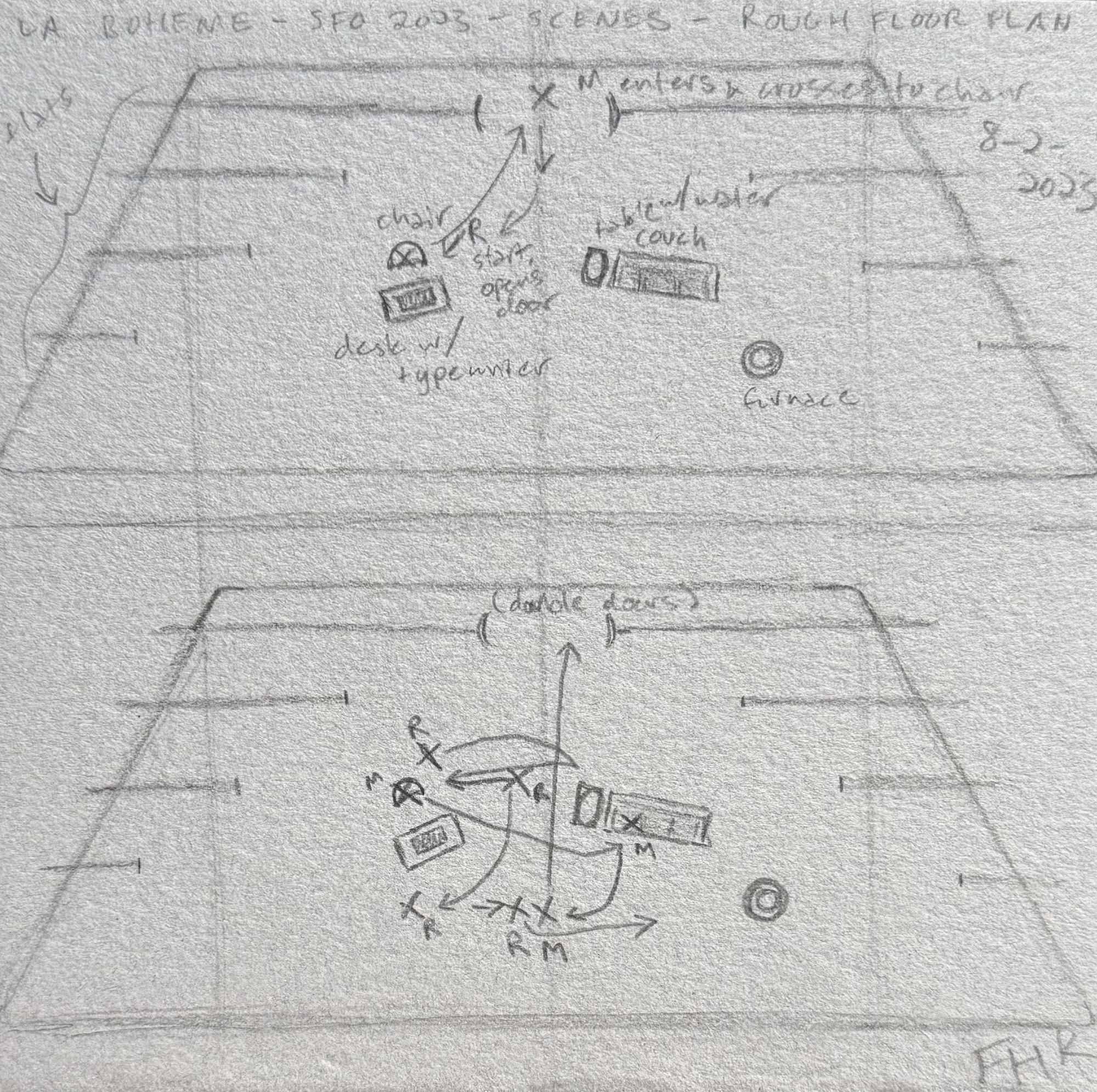
Whether it’s during my 15 minute break, or throughout a long day of observation, there’s usually a convenient opportunity to pull out my little sketchbook, at least for a few minutes. It’s a perfect activity for rehearsals: it’s nearly silent, it keeps me engaged with the onstage happenings, and it can be instantly plopped on the ground if my cue comes up. Plus, the actors who are actually occupying the stage at the moment are often staying in the same or similar positions for long durations of time–an ideal setup to practice gestural sketches.

The publication of this collection of sketches is much delayed! They’re from my most recent summer at the Santa Fe Opera, where I performed as a supernumerary (the “Mélisande doppelgänger”) in the Debussy opera Pelléas et Mélisande, and observed rehearsals for the Apprentice Scenes Program. These sketches are all from the scenes directed by the wonderful Crystal Manich that summer, who so kindly let me sit in and watch! I am always grateful to be invited into a rehearsal room; there are skills to be learned and practiced every time, and I try to make the most of it.

In these sketches, I had a few goals:
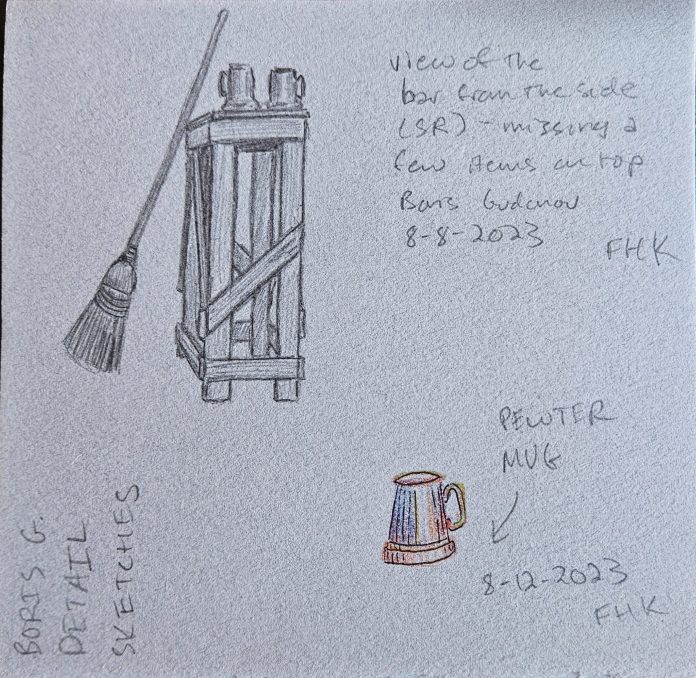
-practice quickly sketching objects from life
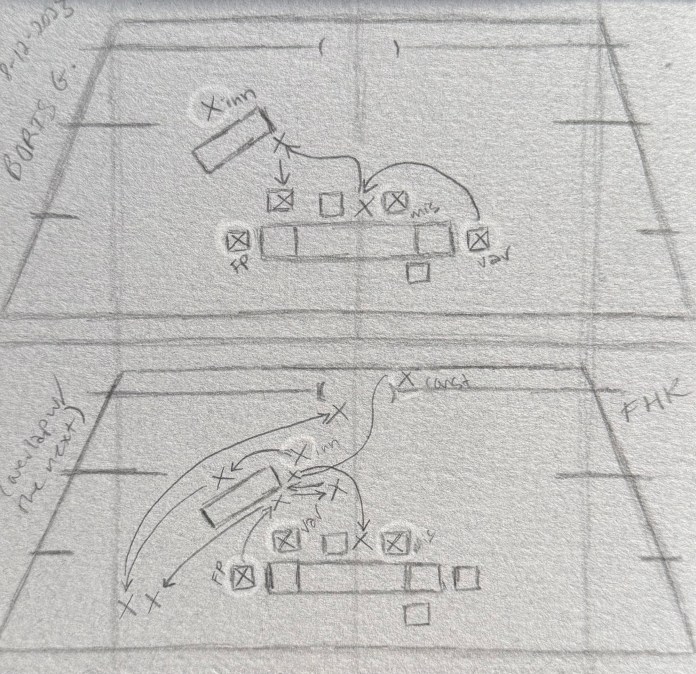
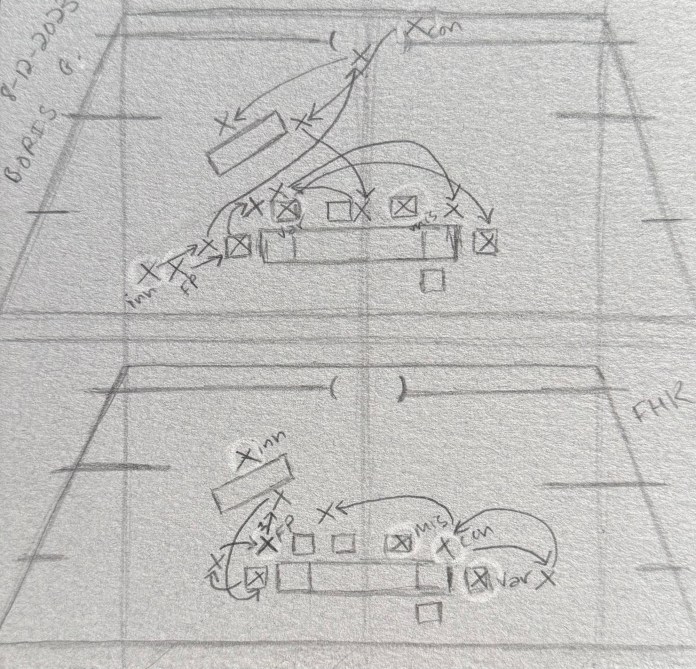
-practice taking multi-character blocking notation on the same page
-practice proportional representation of a stage area

While these sketches are quick, informal, and use quite a bit of shorthand, I believe I accomplished my goals–further, I believe I could easily recreate the staging of these scenes based on the sketches alone, two years later (precise stage business and use of props may be another story, however).

Each slideshow gallery contains the sketches from one scene, and is accompanied by information on the collaborators whose work or physical image contributed to sketch source material. The programs for all the Apprentice Scenes that year can be found here as well. Some of the physical drawings have been gifted away, but some remain in my records, and so the photos weren’t all taken at once, and may have some variation in lighting and quality. I also like to sketch on a non-white base paper when possible, but I’ve discovered this doesn’t always provide starkly visible contrast to pencil markings, unfortunately! All caveats aside, I’m glad to finally share them.

Enjoy!


Gianni Schicchi

Giacomo Puccini | Giovacchino Forzano
“Era uguale la voce…Addio, Firenze”

Gianni Schicchi | Joel Balzun
Lauretta | Lydia Grindatto
Zita | Michelle Mariposa
Ciesca | Emma Rose Sorenson
Nella | Nicole Elyse Keeling
Rinuccio | Lawrence Barasa
Gherardo | Garrett Evers
Marco | Brandon Bell
Simone | Luke Harnish
Betto | Younggwang Park

Conductor | Mark Morash
Stage Director | Crystal Manich
Pianist/Coach | Blair Salter
Costume Designer | Azaria Jade Rubio
Assistant Costume Designer | Matthew Palacios
Wigs & Make-Up Designer | Court Winterborne
Lighting Designer | Will Loconto

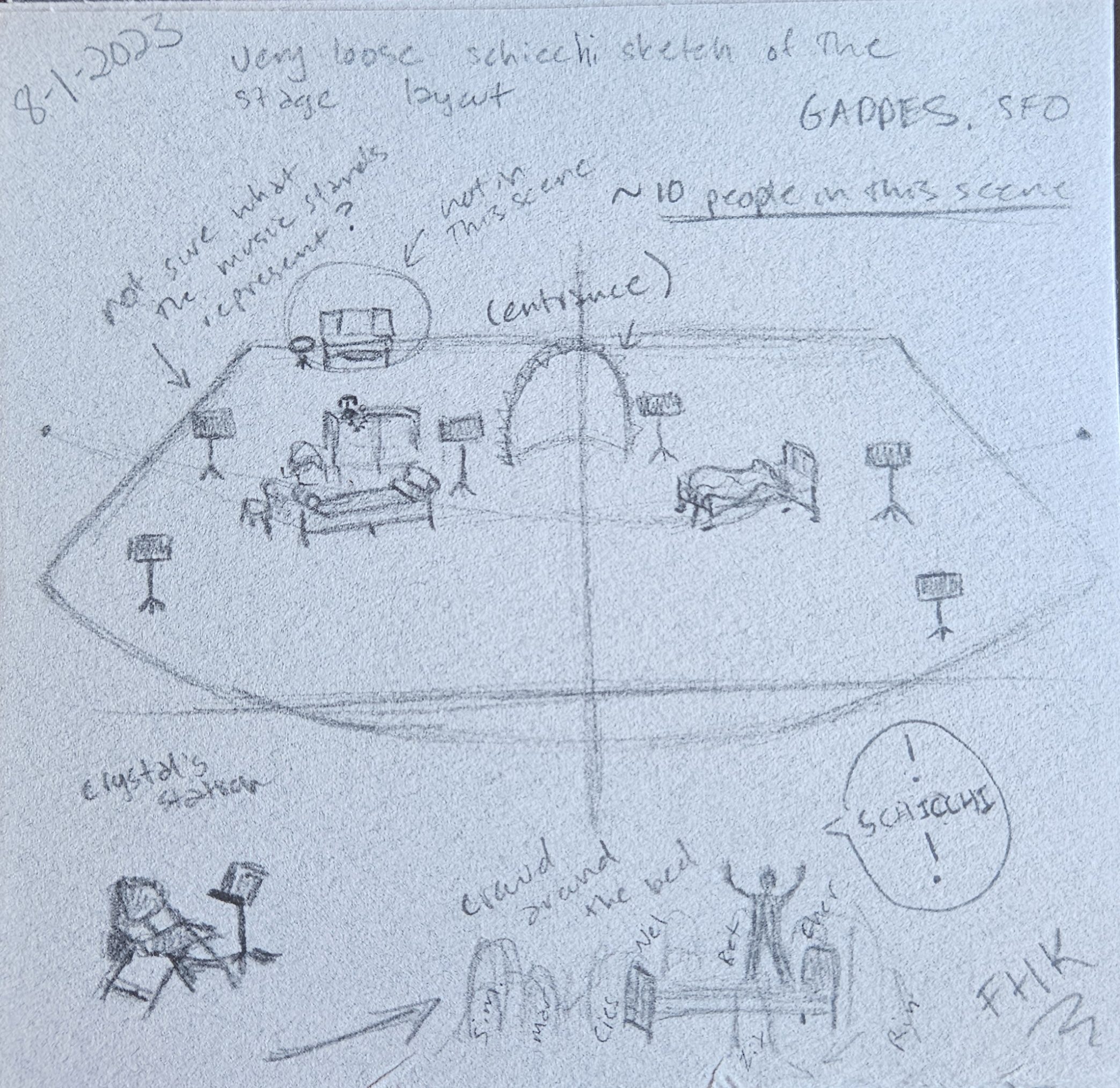
The stage from a tilted front perspective, with two sketches of the rehearsal atmosphere.
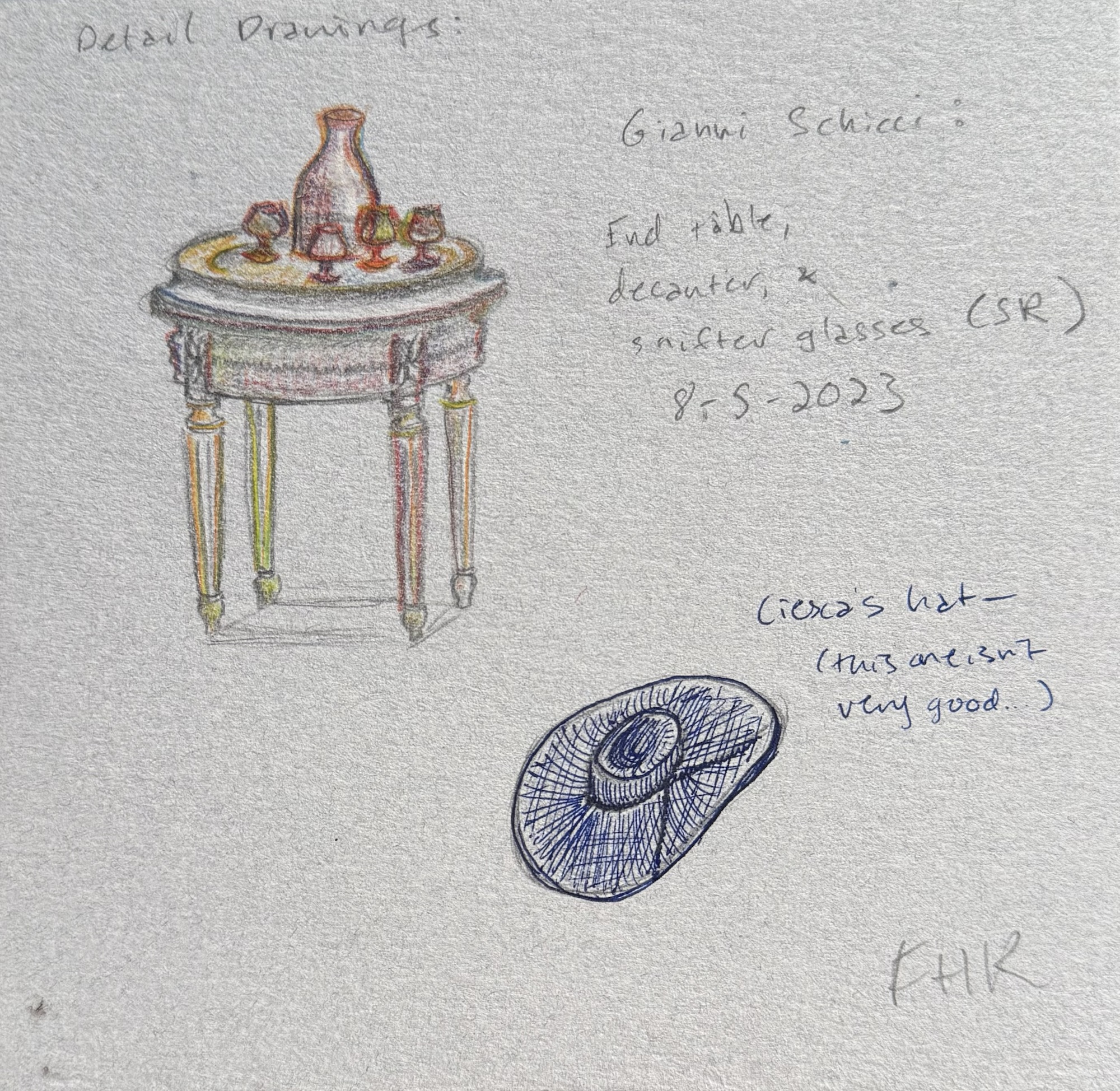
Detail drawings of furniture and rehearsal costumes.
Top of the scene: the family discusses Gianni Schicchi.
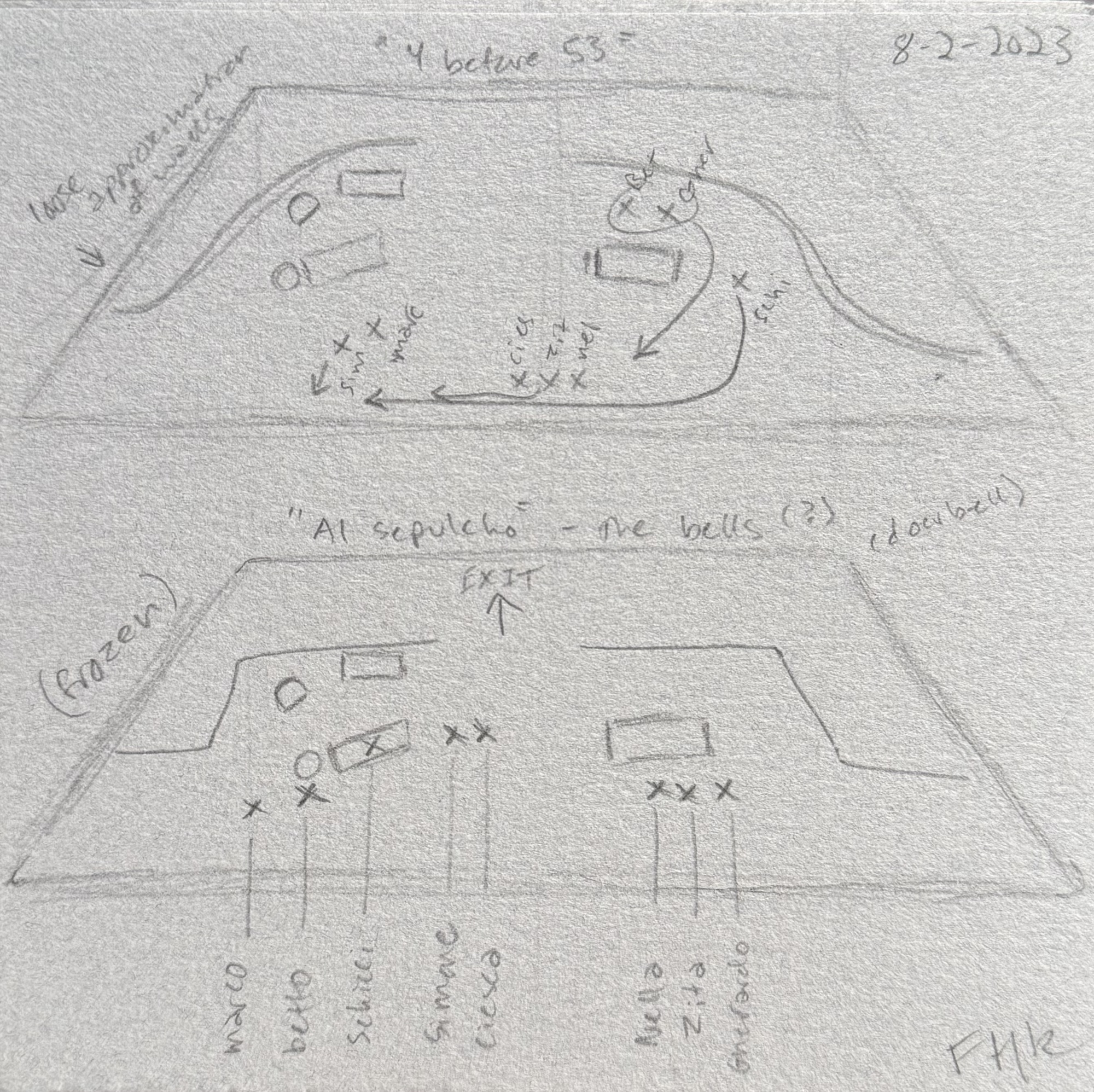
The scene progresses; Schicchi arrives and the plan unhatches.
The scene continues; the family and Schicchi anticipate success.
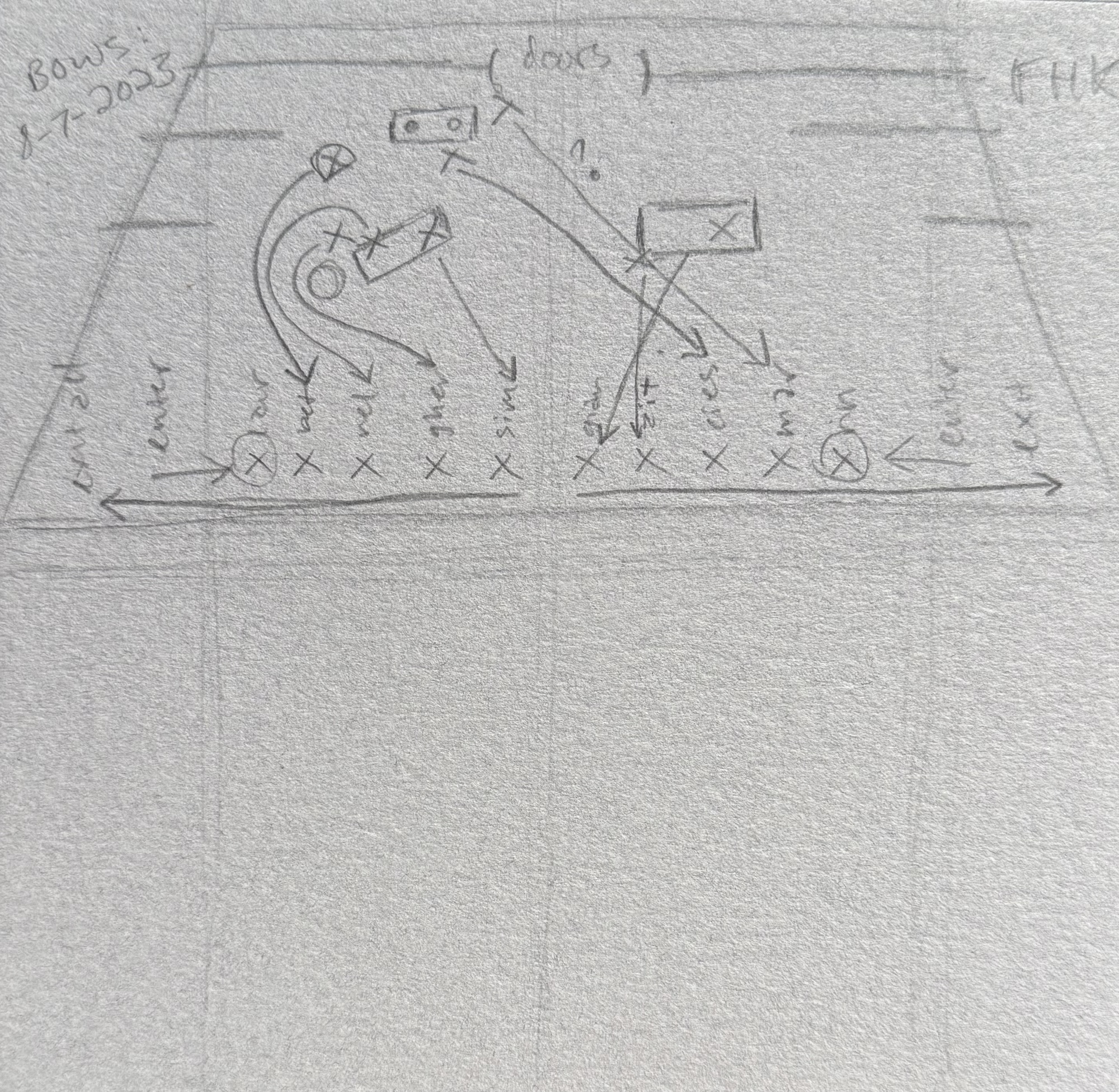
Bows!

La bohème

Detail drawings of a moment of staging and some furniture.
The scene begins; Rodolfo’s life is changed when Mimi walks in.
We move through two arias and a duet; the scene ends with the lovers leaving, full of hope.

Giacomo Puccini | Luigi Illica and Giuseppe Giacosa
End of Act I

Mimì | Caitlin Gotimer
Rodolfo | Daniel O’Hearn (Guest Artist)
Schaunard | Spencer Reichman (Off Stage)
Coline | Christian Simmons (Off Stage)
Marcello | Sam Dhobhany (Off Stage)

Conductor | Robert Tweten
Stage Director | Crystal Manich
Pianist/Coach | Anna Smigelskaya
Costume Designer | Aurora Azbill
Wigs & Make-Up Designer | Joshua N. Wisham
Lighting Designer | Eric Dahlgren


Boris Godunov

Modest Mussorgsky | Modest Mussorgsky
Quintet

Innkeeper | Gretchen Krupp
Varlaam | Le Bu
Misail | Spencer Hamlin
False Prince | Samuel White
Nikitic | Dylan Gregg

Conductor | Alden Gatt
Stage Director | Crystal Manich
Pianist/Coach | Anna Smigelskaya
Costume Designer | Gray Covert
Wigs & Make-Up Designer | Braxton Cooper
Lighting Designer | Brianna Maruco

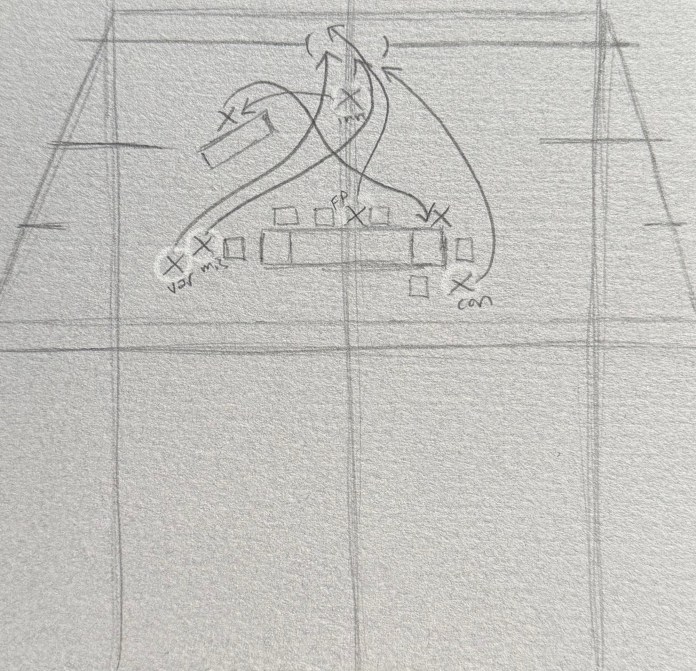
Detail drawings of props and furniture.
The initial layout of the scene.
The scene begins; the innkeeper starts opening up shop.
The scene continues; different folks start to mingle around the table.
The scene progresses; some of the visitors are harboring secrets.
Chaos and confusion as someone is not who he says he is!

Sweeney Todd

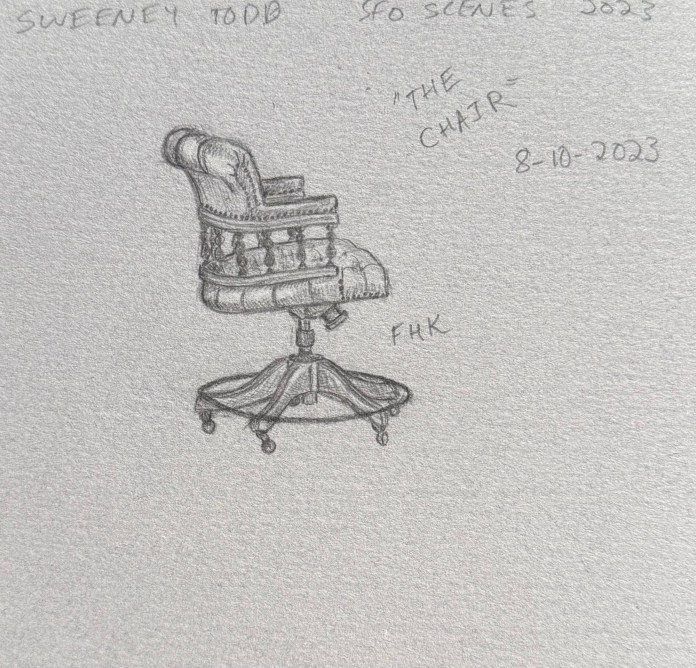
Detail drawing of Sweeney’s barber chair.
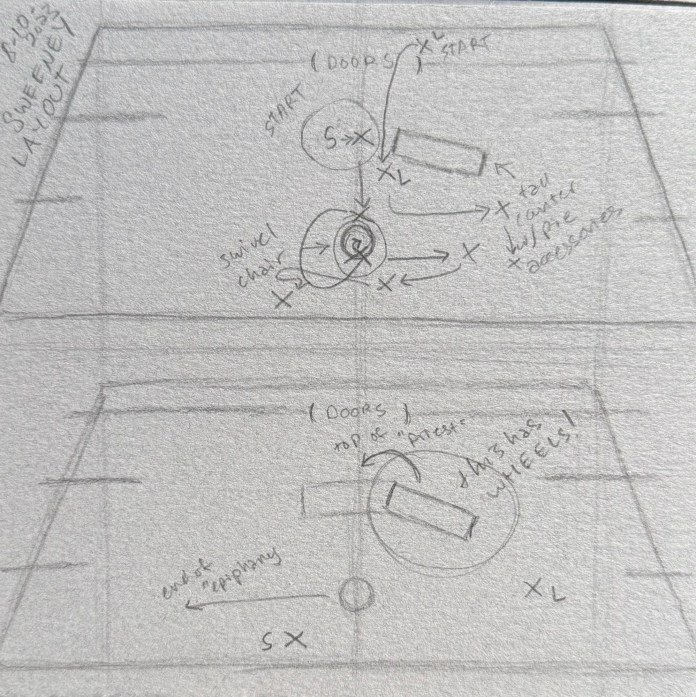
The layout of the set and start of “Epiphany.”
Mrs. Lovett’s brilliant idea turns into a playfully violent duet.
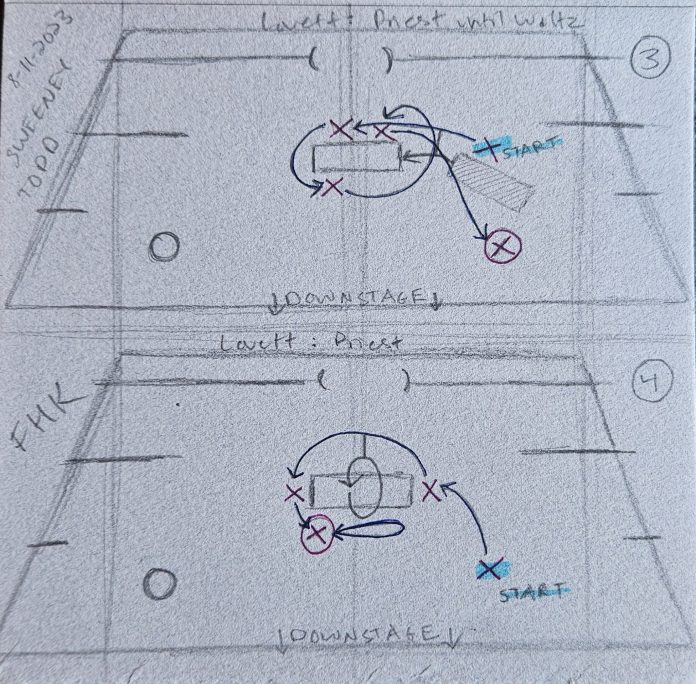
Solo Lovett track, starting with “Epiphany.”
Solo Lovett track continues, starting “A Little Priest.”
Solo Lovett track, finishing the scene.

Stephen Sondheim | Stephen Sondheim
Epiphany and A Little Priest

Sweeney Todd | Spencer Reichman
Mrs. Lovett | Rebekah Daly

Conductor | Robert Tweten
Stage Director | Crystal Manich
Pianist/Coach | Carol Anderson
Costume Designer | Emma Rose Harrison
Wigs & Make-Up | Designer Jax Cornett
Lighting Designer | Brianna Maruco


And if you made it this far… consider asking me to be a part of your theatrical team; you’ll get sketches out of it, for sure.

Standard

The 2024 Summary, and 2025 Aims

New Year’s Eve (and subsequently, Day) is my favorite holiday, and has been for some time, ever since my close hometown friends and I started a many-years-long tradition of throwing NYE parties. I can’t remember exactly when it started, but in something like 6th or 7th grade, we drank our fill of sparkling grape juice, threw handfuls of confetti all over someone’s carpeted Michigan basement, and that was the beginning of everything.

Aside from the parties with friends and enjoying a good secular holiday, I love celebrating the New Year because I love transitional moments; I love reflecting on the year that has passed, thinking through the long list of surprises, lessons, and achievements, and anticipating more to come in the next year… and there will be so much!

Last year was honestly wild, and I’ll show you what I mean–

In 2024, I:
-Visited 4 Countries: USA, Denmark, Germany, Italy (and flew through 4 more: Iceland, Switzerland, Netherlands, and Ireland). 🧳
-Moved from NYC, NY to Berlin, Germany! 🇩🇪
-Visited my home state, Michigan, twice. 🍒
-Got a bilateral salpingectomy. 🎉
-Designed and shot my short film, Venus Retrospectives (currently in the editing process). 🎬
-Debuted my short play, “Black Market Inspiration,” at AMT Theater off-broadway, as part of their New Works Development Program. 🎭
-Completed 2 German courses with the Goethe Institut, and started a third (which will complete my A2 level learning). ✅
-Worked on 15 different productions/shows/events with Chelsea Factory NYC, usually as the Venue Coordinator. 📋
-Worked as the Assistant Production Manager for SUMO, with Ma-Yi Theatre Company (to be performed at The Public in March 2025)! 📅
-Saw a TON of plays, musicals, operas, dance pieces, concerts, and performances of all varieties! 🎵
-Visited a bunch of museums, and sketched at le Gallerie degli Uffizi and la Galleria dell’Accademia in Florence, Italy! 🎨
-Read several books, including physical copies, kindle editions, and good old library books. 📚
-Turned 30!!! 🥳
-Celebrated 1 year of marriage, and 9 of togetherness, with Tom (and we got new ear piercings to mark the occasion)! 💕

… And that’s just about all that I have the patience to tally up right now.

For the new year, I of course have equally ambitious aims (though I would prefer to avoid moving again for a while). I usually don’t share my goals, instead choosing to conceal any failures I might experience along the way… but this year, I want to be seen trying, whether I reach my aims or not. (Aside–did anyone else get called a “try-hard” in high school, as an insult? Can we unpack that together?)
So, here are the 2025 Aims!
-Create something every day (take creative action: make something that was not there before, even if it is small, or part of a larger project).
-Do either a sun or moon salutation every day, with a few minutes of meditation.
-Update or work on my professional website (frannykromminga.com) once a month.
-Fully finish Venus Retrospectives!
-Complete B1 level German training (via the Goethe Institut).
-Travel somewhere new!
-Read 25 books.
-Visit 25 museums (different collections on separate visits to the same museum are allowed).
-See 25 live performances (in-person).
-Get 25 rejections from applications/auditions/submissions… then double it to 50 in the second half of the year!
-Make 25 posts on The Franifesto.

Ambitious! But certainly achievable, and many of the goals overlap. For example, this post here is my “create something” for day 5 of the new year, and one of the 25 intended posts. The number 25 also seemed perfect for many of the aims, both because of the reference to the year 2025, and because it means I will need to accomplish one of each of those categories roughly every ~2 weeks. So far, so good: four days in, I am especially loving the creativity goal, because it’s often hard for me to prioritize something that is coded as “frivolous” in our capitalistic western society, even when I know it’s actually deeply important.

I’ll be tracking all of these, attempting to record them all in my little notes app; I plan to mark down what books and shows I experience, list when I write my posts, sketch at all the museums, and even count how many sun-versus-moon salutations I do. So, if you’re curious about how it all shakes out, meet me here next year: same time, same place!

In the meantime–enjoy a video I edited with some of my favorite little clips of 2024~

Happy New Year, and may you have a healthy, joyful, and prosperous 2025!

Standard

Black vinyl flooring greets my boots, all specked with city dust
Containing flecks of concrete, stone, dirt, grime, and gritty rust:
But only a little bit of grit sticks upon my shoe,
And I track it through the gridded streets, off to somewhere new.
The soles of my feet carry a record of time and place
That keeps me grounded, so to speak, in this liminal space.

The Liminal

Image

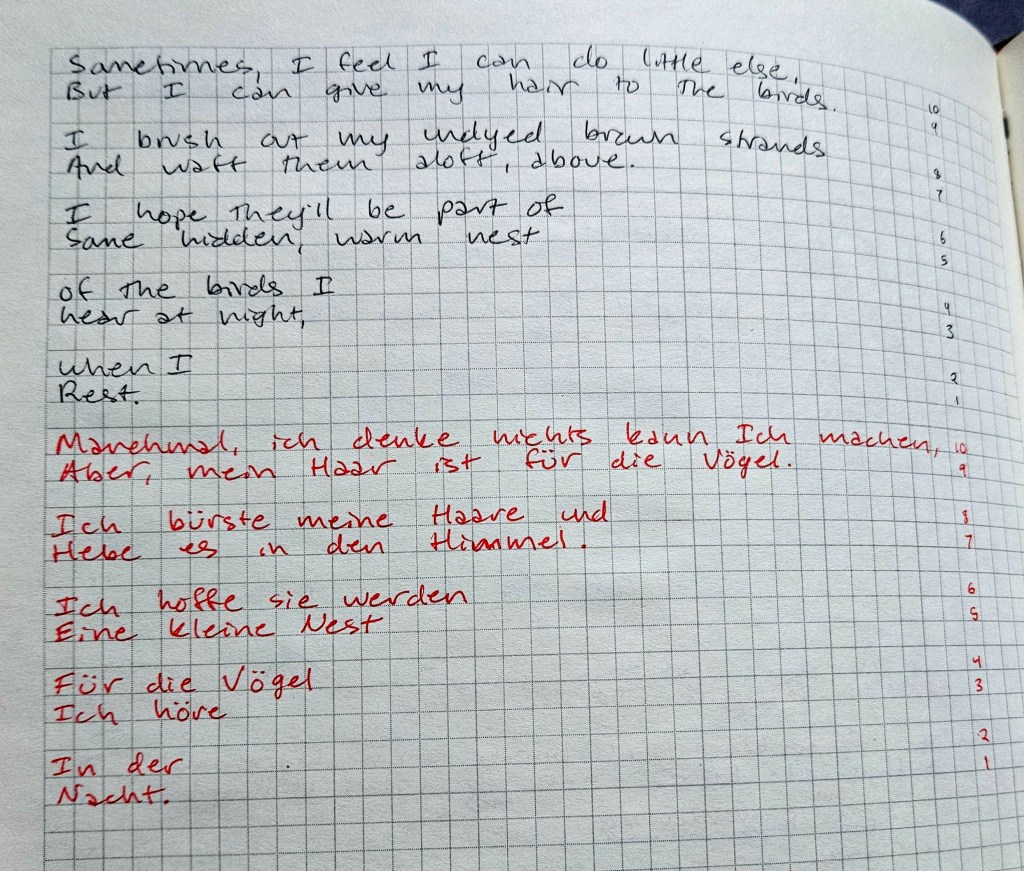
I’ve been learning German lately, and something that I found fun was writing a poem, then immediately translating it to a German version that captures the same form and feeling.

Sometimes, I feel I can do little else,
But I can give my hair to the birds.

I brush out my undyed brown strands
And waft them aloft, above.

I hope they'll be part of
Some hidden, warm nest

Of the birds I
Hear at night,

When I
Rest.

Manchmal, ich denke nichts kann ich machen,
Aber, mein Haar ist für die Vögel.

Ich bürste meine Haare und
Hebe es in den Himmel.

Ich hoffe sie werden
Eine kleine Nest

Für die Vögel
Ich höre

In der
Nacht.

(In my draft, I switched to red ink when I had to look up translating help.)

I’ll definitely be doing this again. It gave me the chance to sort of re-compose and re-examine the poem, giving it more context to be understood, albeit only for those who have access to both languages.

I think more of these will be forthcoming!

“For the Birds/Für die Vögel”

Image

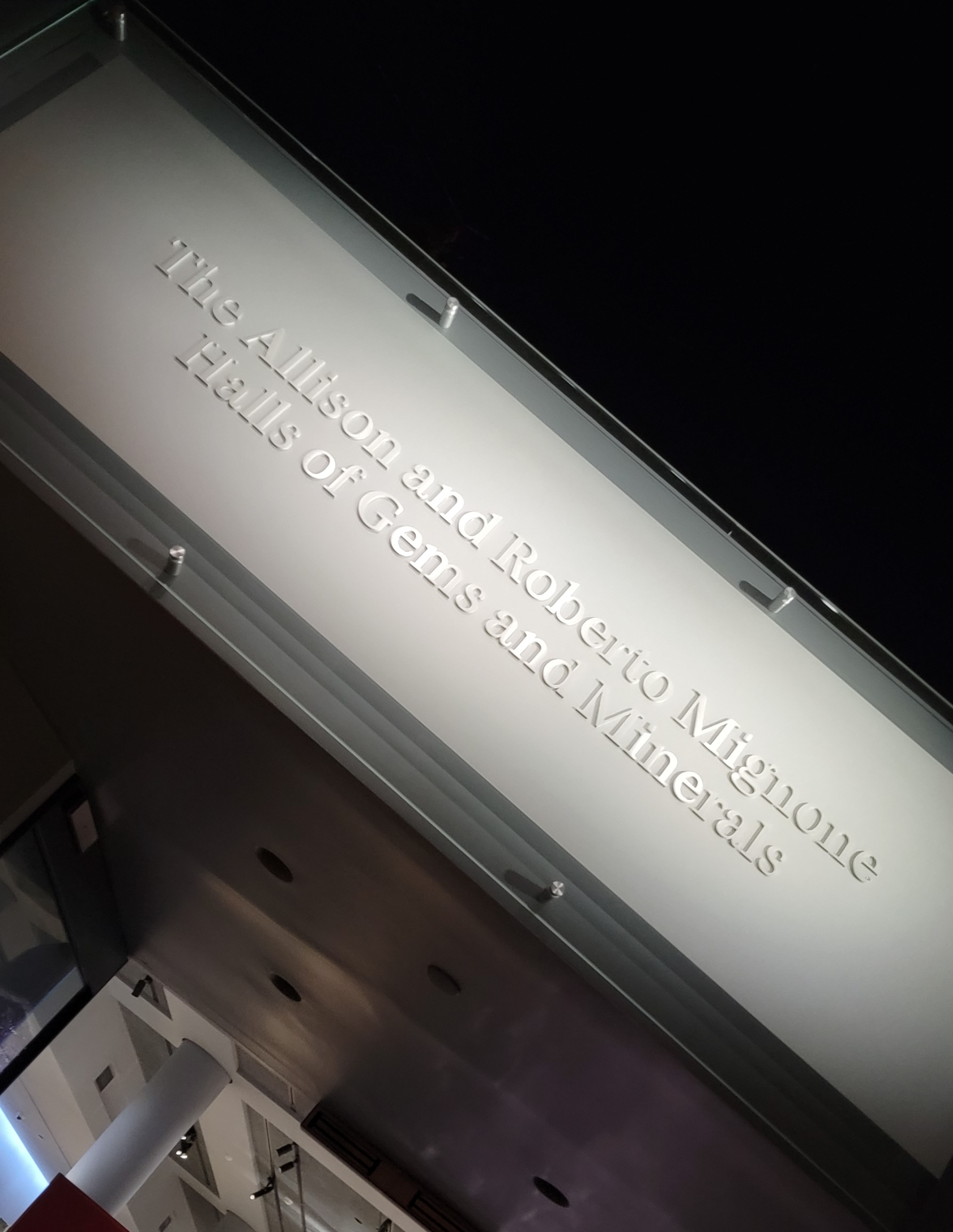
Illuminating Sparkle & Rock-Solid Foundation: The new Allison and Roberto Mignone Halls of Gems and Minerals at the American Museum of Natural History in NYC

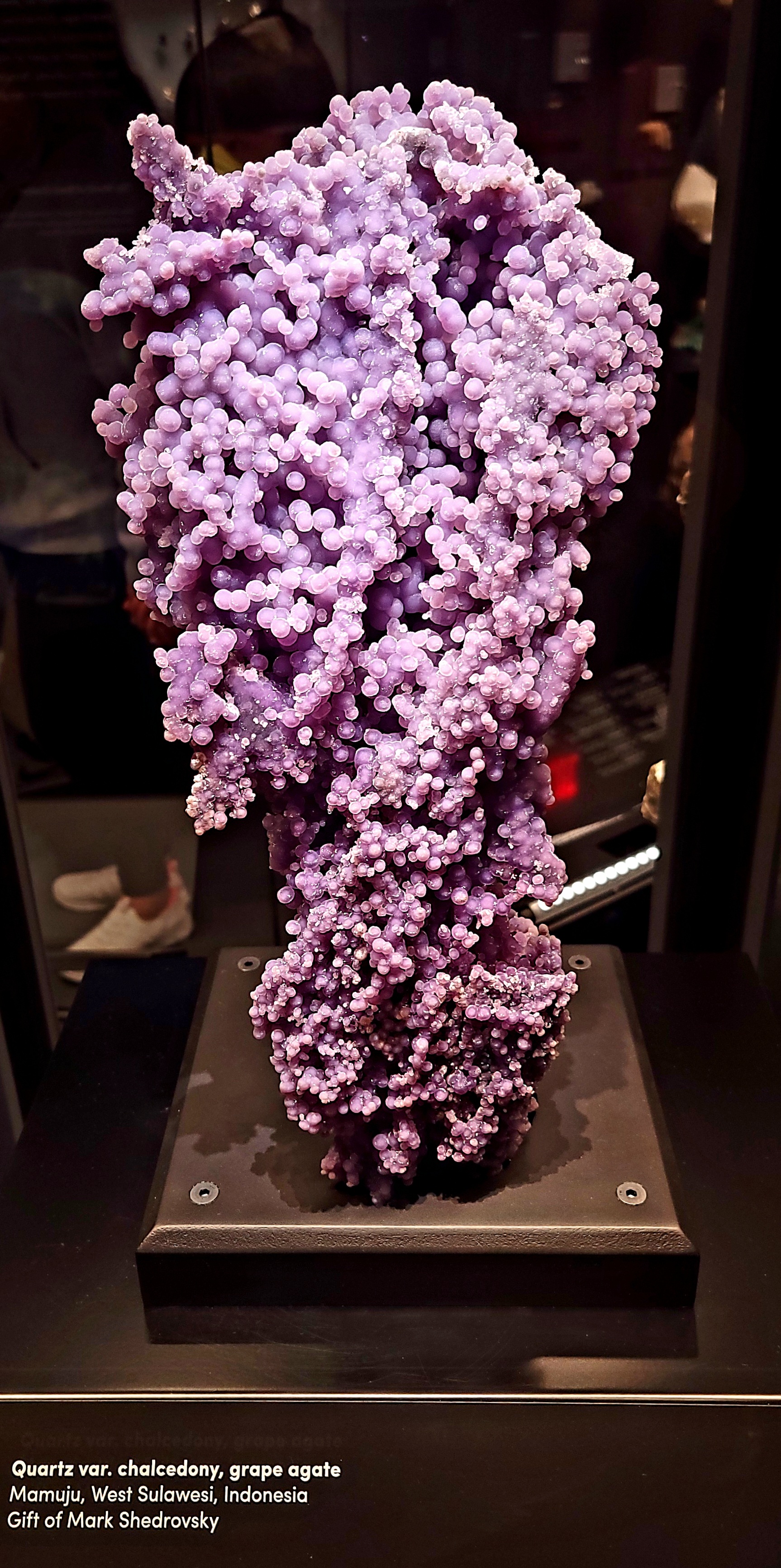
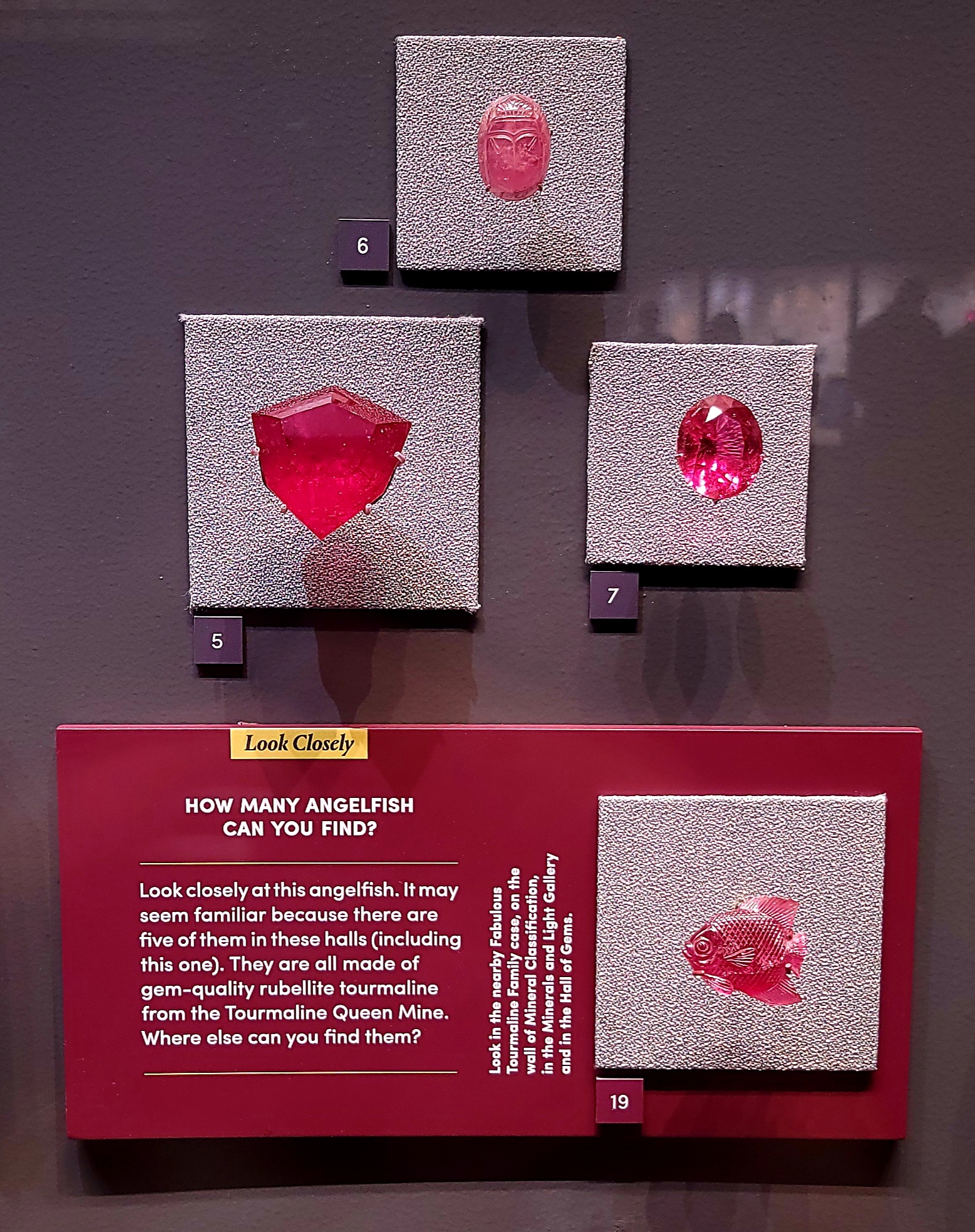
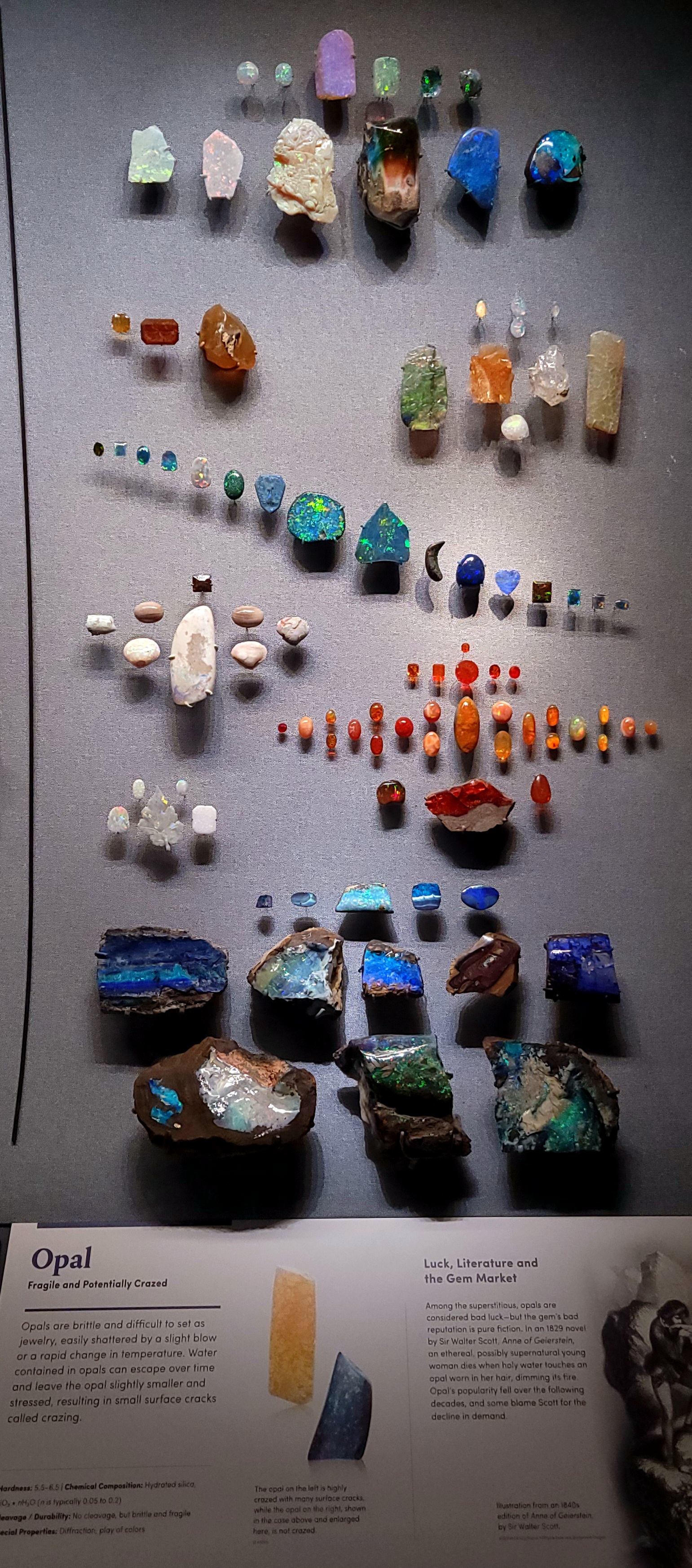
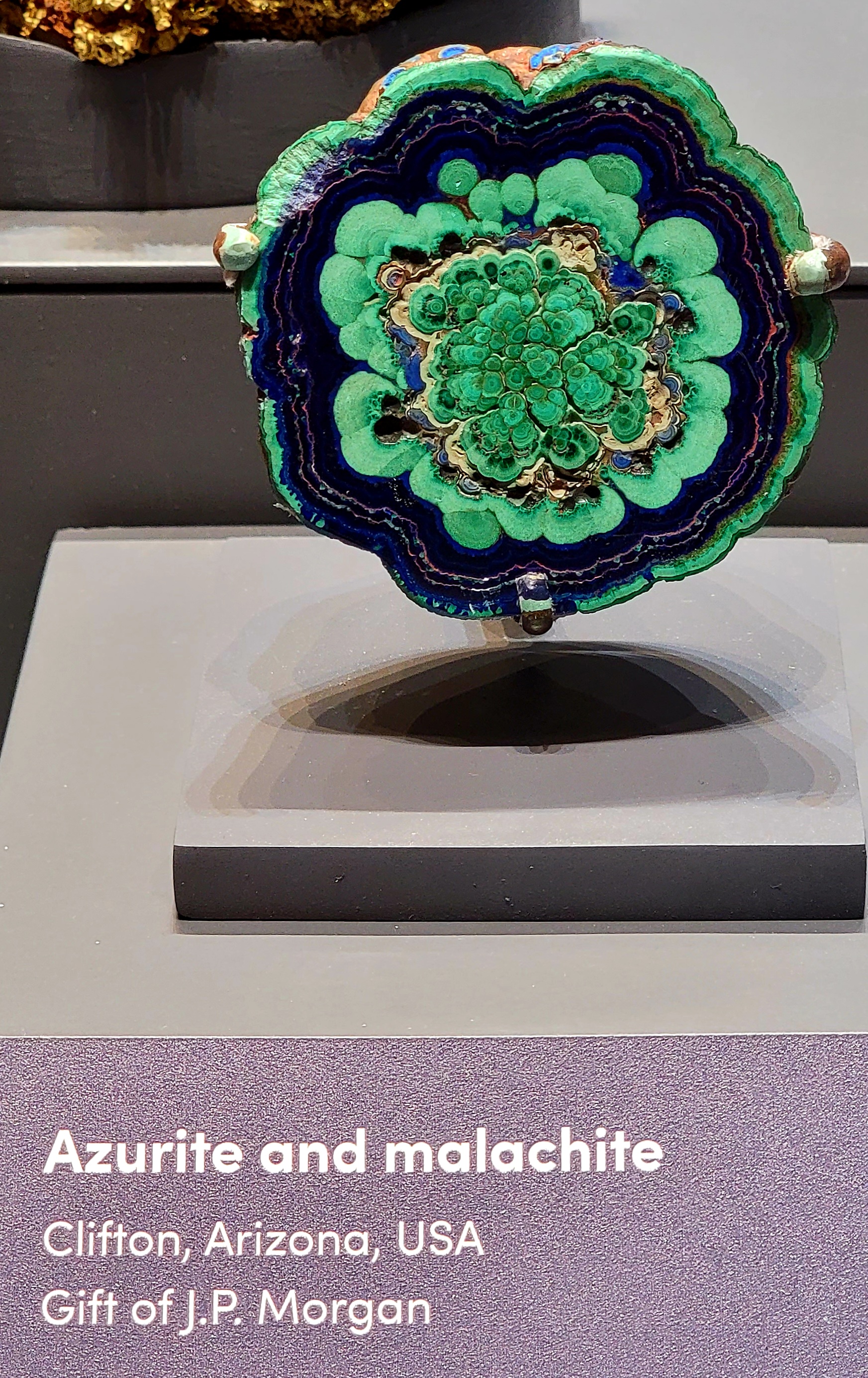
I love rocks. Anyone who knows me can tell you this. I have loved them since I was a small child, poring over the geology pages of my children’s encyclopedia, lingering over the glossy images of fluorite, quartz, and sapphire. I remember studying field guides for fun, and effortlessly acing my science quizzes on volcanoes and tectonics. As an adult, I have a tiny gem collection of my own, and have become a bit of a connoisseur of gem and mineral displays of both the educational and commercial variety. I have seen the Smithsonian’s dazzling array, looked at every booth at the Denver Gem & Rock Show, combed Oregon beaches for loose agates, devotedly searched for a rare color-change garnet suitable for my engagement ring, and more. I always enjoy a gem & mineral display, but at this point it takes some real oomph to stand out.

The new Mignone Halls of Gems and Minerals at the American Museum of Natural History did not disappoint.

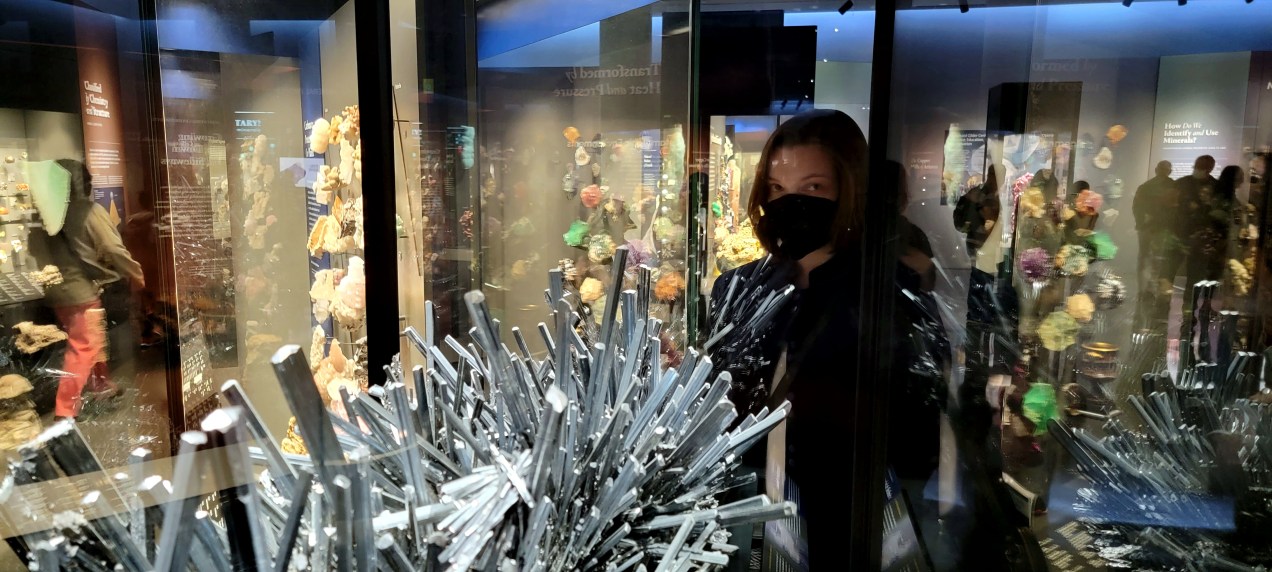
I and my partner chose to visit on April 22, 2022, which happened to be Earth Day—a fact we’d forgotten would mean attending the museum with dozens of school field trips and science-minded families. The added crowd turned out to be pleasant, however, as we got to see how people of all ages, particularly impressionable ages, interacted with the new exhibit. I couldn’t help but grin at each child’s reverent ”ooooooh,” uttered upon seeing a spectacular sparkle. Gems, ever fascinating, were very popular on Earth Day.

When you enter the exhibit as it currently stands, you’re immediately greeted by a colossal pair of amethyst geodes, cracked open and glittering deep violet. It’s a charming photo opportunity and serves as a bold welcome, showing visitors what is to be expected ahead.

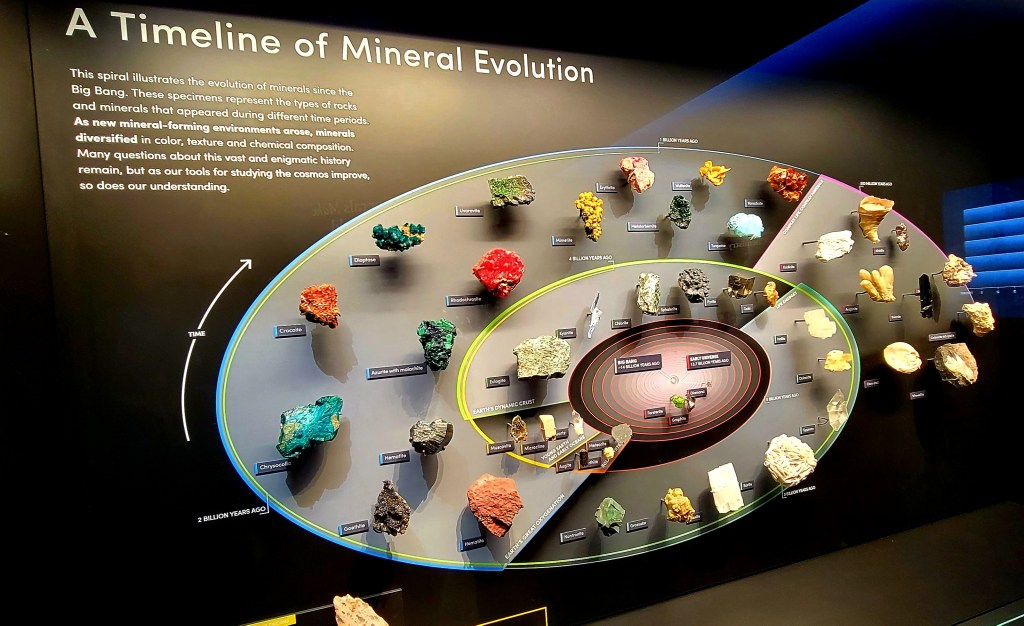
After the geode entrance display, we turned to the left, and it’s there that my great opinion began to form; the Mignone Halls are the only exhibit I have seen to include the concept of Mineral Evolution, which describes the changes through time from the Big Bang to now that chemically allowed new minerals to form. This provides a fantastic context for understanding what minerals really are and how they came to be, and I haven’t seen it so clearly laid out in any other setting.

The exhibit is also sure to point out the necessity of minerals to the existence of life, and how some minerals only exist because of life. I have rarely seen the vitality of minerals demonstrated so concisely, and of course accompanied by twinkling specimens and memorable anecdotes.

Further, the Halls outline the industrial, historical, and cultural importance of minerals and gems. Rocks and minerals are inseparable from human history, and gems have been objects of desire and fascination since before recorded history. Something I admired was that these displays professed the importance of function and form equally; self-adornment has held just as much value, culturally, as making tools.

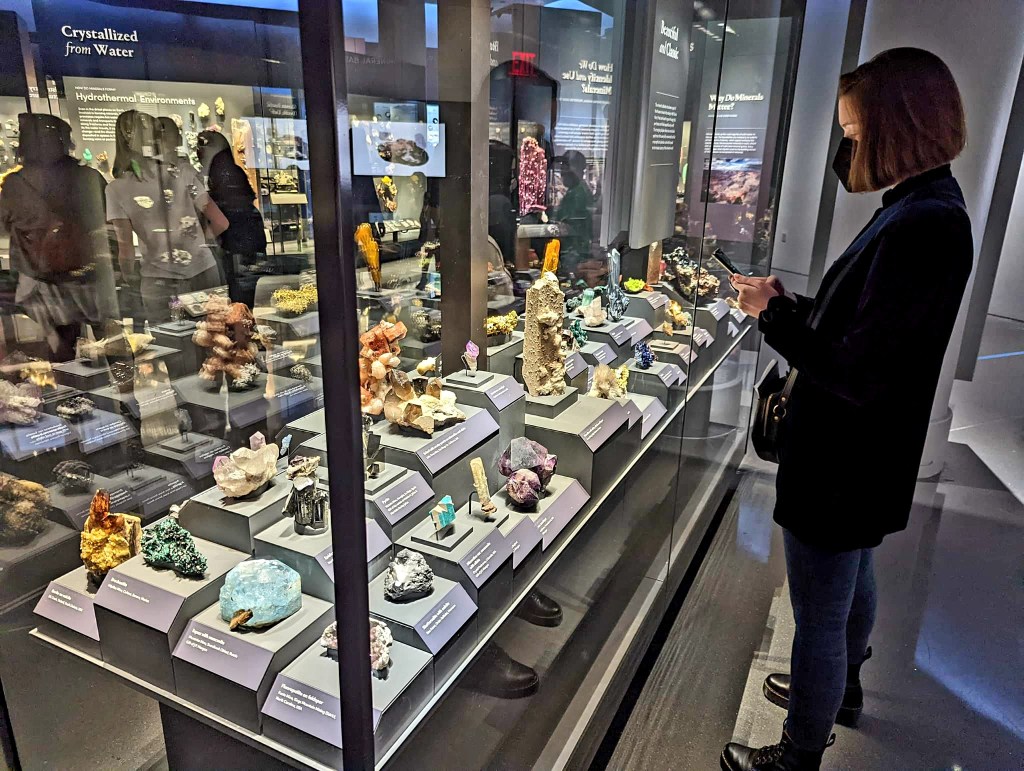
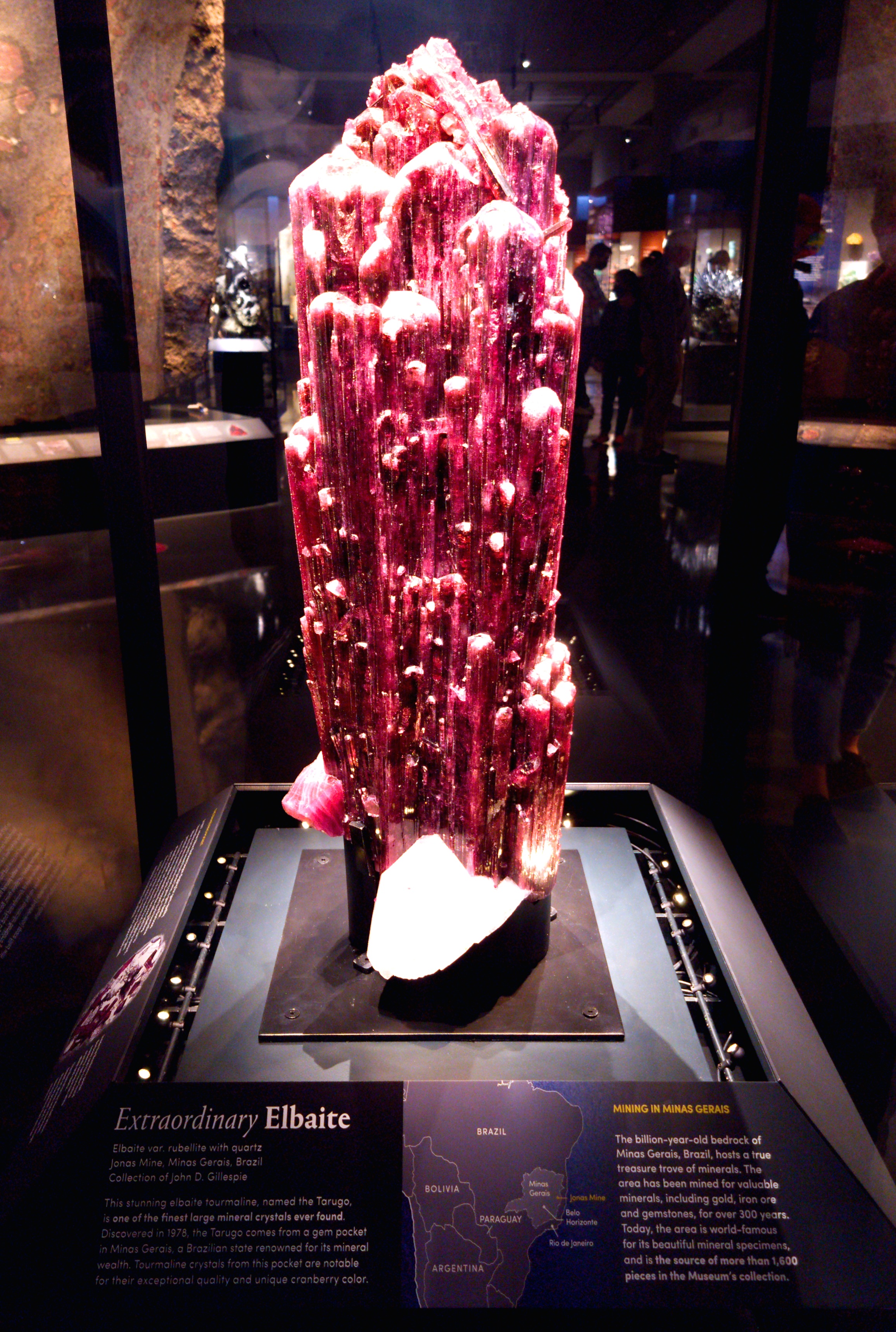
Throughout the Halls, we learn enough for a college course in geology; I would know, I took one. This includes but is not limited to: chemical classification of minerals, how to identify different minerals in the field, crystal growth & structure, social & environmental costs of gem mining, erosion & weathering, fluorescence, organic & synthetic gems, light & refraction, minerals local to the NYC area, Moh’s hardness, history of salt and its uses, plate tectonics, etc. This is all delightfully accessorized with enormous specimens, some of which we are even encouraged to touch. Interactive displays help to cement the day’s learning and add a playful element to it, and seemed to be enjoyed by kids and adults alike. Lastly, we are treated to a fully-stocked jewel-box alcove simply clustered with some of the finest gemstones ever found and faceted.

Entrance to the Mignone Halls of Gems and Minerals is included with general admission to the museum, and I highly recommend a visit. We wandered the space for about three hours, having fun admiring the specimens and trying to guess what they were before checking their information on the placards below. The whole exhibit is thick with information, some of it easier to absorb if you’ve had prior introduction to scientific concepts, particularly chemistry. A visitor can easily spend hours reading up on rocks, or enjoy a gleaming stroll through the treasure hoard; if gemstones happen to hypnotize you, you’ll be a happy visitor indeed.

Standard

Hmm, says she: a Sonnet

Hmm, says she, I’ve been doing some thinking
About the water we have been drinking.
More common than dirt, more precious than gold,
Each and every drop a million years old.
How is it then that we are running out,
Getting scarce in every spigot and spout?
The rain still comes and the rivers still run,
But still it’s not enough… for everyone.
Some people still bathe, and steam, and shower–
Of course, they’re the ones with all the power.
Others go parched, chronic dehydration;
Ah, such “equality” in our nation.
I can’t help but feel we’ve gone all awry,
All because of an oily, greedy lie.

Standard